|
 Log in |
Register Log in |
Register
|

|
|


St Canna's StoneNatural Rock Feature
|
||||||||||||||||||||||||


 0 discussions


 Show map (inline Google Map)
|
|
|
Images (click to view fullsize) |
 Add an image Add an image |
Photographs: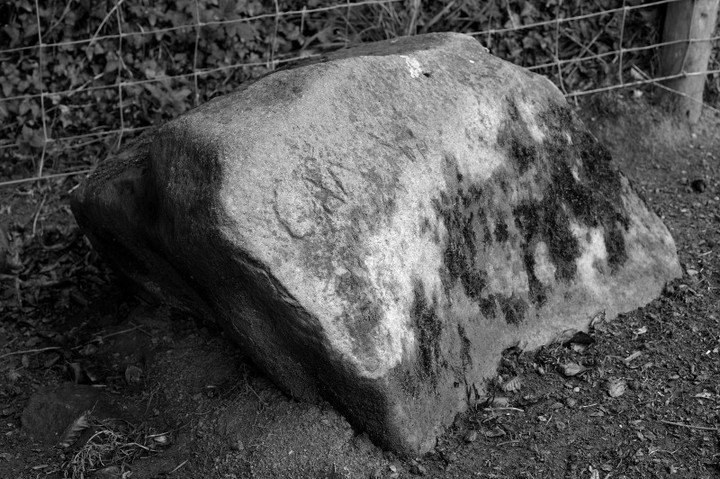 Artistic / Interpretive: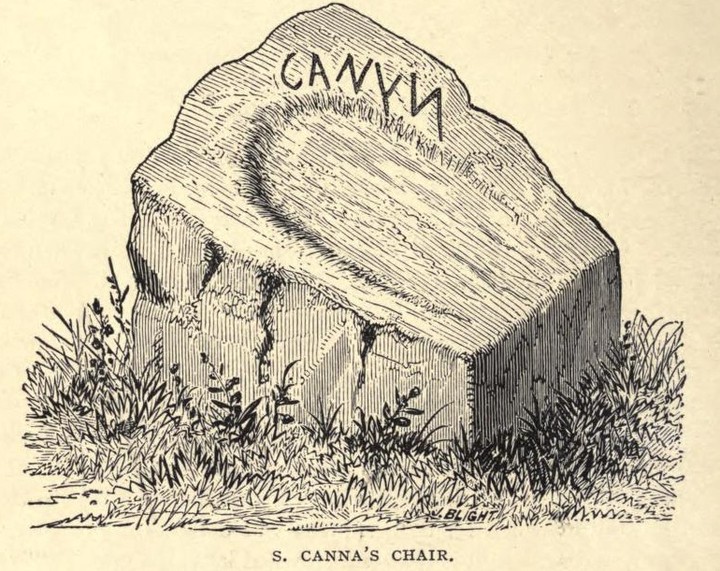
|
Fieldnotes |
Add fieldnotes |
|
Visited 15.4.14 Directions: Take the minor road north out of Whitland. Drive through Cwmfelin Boeth and then take the first turning on the left. Continue straight on at the junction. At the point the tarmac road turns to gravel is a house on the right – park here. Opposite the house is a gated entrance to a dilapidated church. Walk down the overgrown path and just before you reach the graveyard St Canna’s Stone can be seen on the other side of a barbed wire fence on your left. Karen didn’t feel comfortable parking outside the house but I assured her it would be ok. I undid the rope tying the gate closed and looked around for the stone. After an initial unsuccessful search around the graveyard I spotted the stone in the field next to the church. It is just the other side of a barbed wire fence; keeping in a flock of sheep and their lambs. The stone is small (not much of a chair!) and it appears to have been turned around since the photo was taken. It was a bright, sunny day and I was unable to make out the engraved name on the stone. It really isn’t much to look at. At this point I noticed a lady coming out of the house and going over to Karen who was still sat in the car. I headed back in case there was any ‘bother’. There was no need for concern as the lady was very pleasant and it turned out that she owned the field where the stone / sheep / lambs were. She informed me that she knew about the stone and that many lambs had been born next to it as it is in a sheltered spot. She said that she originally came from Maenclochog to the north. I told her that I had been there whilst visiting the nearby Gors Fawr stone circle. She seemed impressed! I said that it was a shame that the old church had been neglected (I tried to have a look around inside but it was locked) She said that someone had bought it in 2000 to turn into a home but has never visited it since! She added that now only one old lady visited the church to tend the grave of a relative. I found it sad that such a fine church / graveyard could be neglected in such a way. It would make a fine home and afford good views. The Preseli Mountains could be seen in the distance. I am glad I visited this site although in all honesty the stone isn’t much to look at. Perhaps if you happen to be in the area and have some spare time it may be worth a look? |
Posted by CARL 16th April 2014ce |
Folklore |
Add folklore |
This relic is a rude stone, forming a kind of chair, lying in a field adjoining the churchyard, and about thirty or forty yards from it. When it was removed to its present position is unknown. There was also a well below the church called Ffynnon Canna; and there is still a small brook available, if required, for following the rules prescribed to those who wish to avail themselves of the curative powers of the saint's chair. It appears that the principal maladies which are thus supposed to be cured are ague and intestinal complaints. The prescribed practice was as follows.More (on the inscription) here in Archaeologia Cambrensis (1875) and here. Coflein puts the stone at SN17701874 and says before 1925 it used to be here SN17751875. But how big is it? You'd think it was too big to move. And (my ultimate excuse for including this stone) surely it was around here near the spring and the special insisted-upon spot before the church turned up. (Perhaps it's smaller than I hope, as the RCAHMW puts it at 28 by 26 inches). I can't find a photo (and I think Ocifant's tried to find the place in person without luck?) but the drawing in 'Lives of the British Saints' shows the slightly ambiguous lettering and the hollow "produced by the multitude and frequency of the devotees". |
 Posted by Rhiannon
13th April 2012ce Edited 25th May 2015ce |
 Top of page