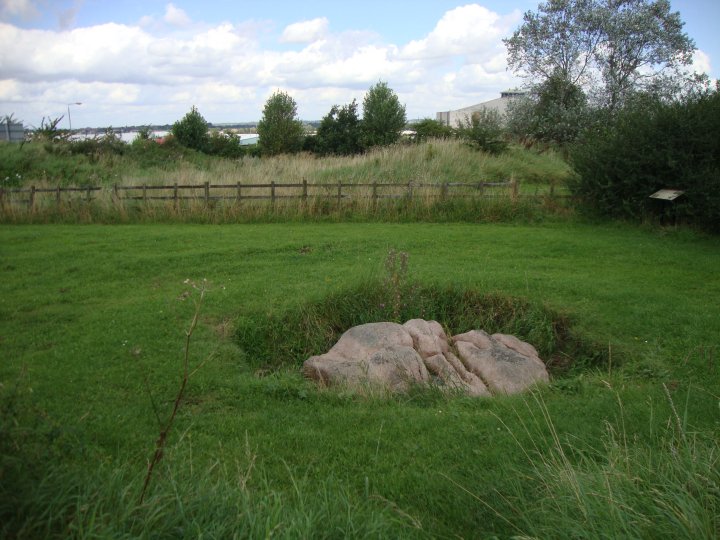
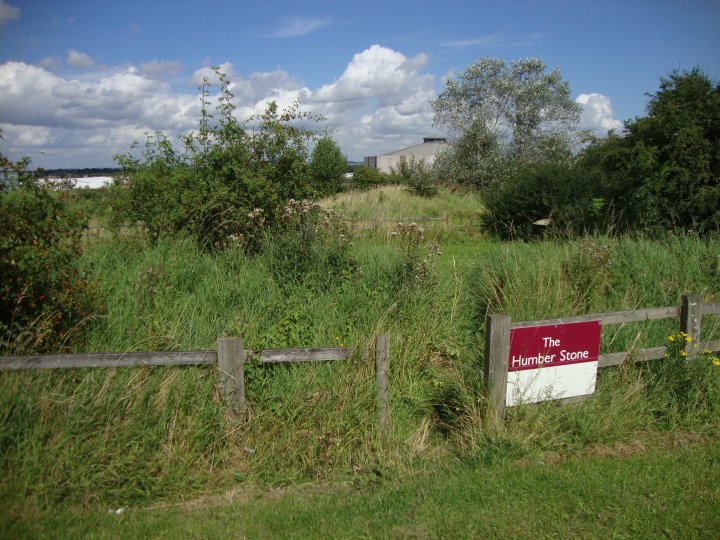
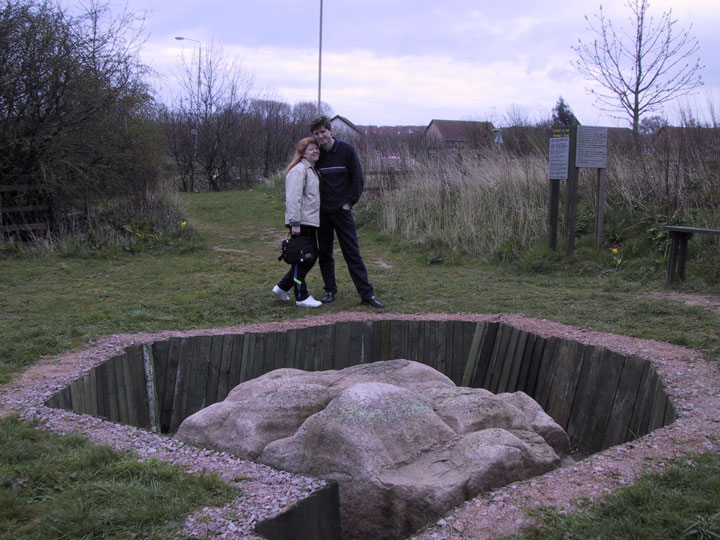
Visited the Humberstone June 2002 and it has now been signposted, and a wood border added to the area around the stone, by the 'Friends of the Humberstone'. Unfortunately I was following a walk in a leaflet by the Stepping Stones Countryside Management Project which led through fields, which triggered a major attack of hay fever. If you're going to visit the Humberstone, drive up to it! It's very close to a roundabout and I couldn't see where you might park, but there has to be somewhere near by. There are a lot of new houses being built in the area, which is worrying, and it isn't difficult to imagine the stone eventually becoming a curiosity in the middle of a large housing estate. We shall see. If you're in the area check out the village/suburb of Humberstone and the Cruck Cottage, and have a look at Pine Tree Avenue - lovely Sequoias.
For some reason best known to the Ordinance Survey, it is the only standing stone in Leicestershire to appear marked on the maps. Maybe this is part of the “Magic” of the Stone, at work, as Leicestershire is dotted with other, more prominent Standing Stones.
The Humber Stone is located near the traffic island of Thurmaston Lane and Sandhill Avenue in the north-east of Leicester, now swallowed up into the conurbation of the city itself.
Estimated to weigh about 15-20 tons, it is of Mountsorrel (or syenite) granite rock, known as a glacial erratic. It may have been deposited during the last ice age, but human intervention in its siting cannot be ruled out. (One theory suggests that it was brought, by glacier, from the Humber, although this is unlikely.)
It is a matter for conjecture as to whether the stone gave its name to the near-by village, (also now within the city limits) or vice versa. There are several theories as to the derivation of the name. Contenders in the etymological stakes include amber or humberd, being of Druidic origin, as well as Humbeart’s Stan meaning “the stone belonging to the tribal chief Humbeart.” It has been known by several names over the centuries, which muddies the waters still further. These include Hoston, Holy Stone, Holstone or Hell Stone.
Ost End is the name of the field to the east of the Stone, and the one to the west is called West End, so the Stone was a landmark when the fields were laid out and named. There is also a Hell Hole Furlong nearby. Hell, Hole and Holy all have the same etymological root and occur in many place names throughout the country.
The Gods of the “Old Religion” (Paganism) became the Devil of the new (Christianity), in many other aspects of folklore and legend. If they couldn’t be “canonised” as in the case of Bride, who became St. Brigit, then they were made into figures of fear and loathing. Those who still worshipped the various aspects of the old Goddess and Her Consort, were often decried as Witches. Their ceremonies were said to be Devil Worship and, therefore, to be despised. In many cases the Christian Church overcame the problem by building their churches on Pagan sites. They even, often unwittingly, included Pagan images in the fabric of the buildings!
All of this further complicates any study of the roots of stories and names of the Stone. It does, however, explain why in some cases things are said to be both lucky and unlucky; it depended whether you heard it from a Christian or a Pagan!
It was extensively excavated in 1878, by William Pochin of nearby Barkby, for a geologist’s report about rocks carried by glaciers. He also removed a large piece of the Stone for analyses. Not long after doing so Mr. Pochin shot off half his hand! There is a photograph in the village archives of a man standing, dwarfed, next to the exposed rock, presumably Mr. Pochin, or one of his workers.
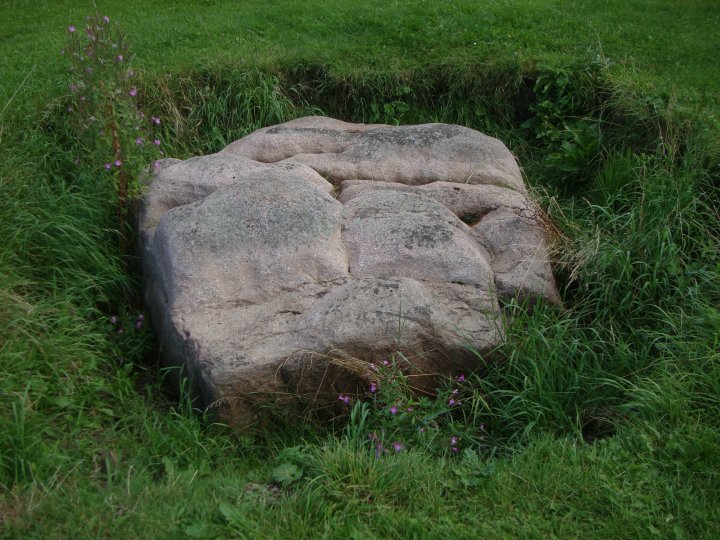
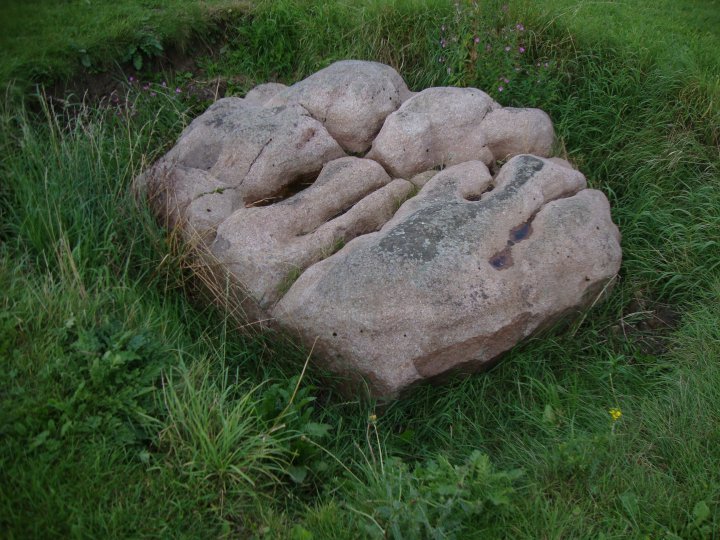
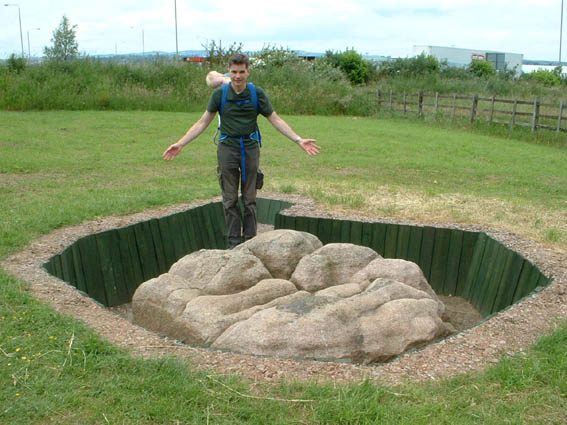
The Stone, recently partially re-excavated by “The Friends of the Humber Stone,” is thought to be some three metres high. However the “Friends” have only uncovered about one metre, as any more would need ground works on an engineering scale to ensure public safety.
It is believed to have stood exposed to the elements in an artificial hollow until about 1750, when the landowner decided to bury it so that the land could be ploughed. He was a Curate, so perhaps he also had ulterior motives for burying the Stone; maybe the locals still revered the old Pagan ways? Whatever his reasons, soon after the Stone had been covered, he was thrown from his gig and killed.
Much mystery and legend surrounds the Stone. Certainly no-one who harms the Stone prospers by doing so. There is a story of a wealthy landowner who broke a chunk off the Stone in the 18th century to try to destroy it so that the land could be used. Just six years later (in 1810), he died penniless and destitute in the parish workhouse!
Another story tells of a man who, whilst passing the Stone by Moonlight on his way home, heard “groaning” and fled in fear of his life.
Many tales relate to the faery-folk who are said to inhabit the Stone. They should on no account be upset, or misfortune in one form or another will befall the miscreant.
There is also rumour of an underground passage between the Stone and Leicester Abbey. This is now a ruin in Abbey Park, northwest Leicester, not far from the site of St. John’s Stone. (This was to be found between the roads of what are now Somerset Avenue and Milverton Avenue, in the north of the city, three miles to the West of the Humber Stone). Although no such tunnel has ever been found, these stories are thought to be folk memories of what have come to be known as “Ley Lines,” or lines of “Earth Energy.”
Other legends attached to the Stone include; if you touch, or worse, break pieces off the Stone your ears will turn to stone and if you fall asleep near or on the Stone you will be captured by the faeries.
There are reports of old people sitting on a huge granite rock at the top of nearby Thurmaston Lane, known locally as “the dangerous hill.” They would bathe their eyes in the pools of rain water that collected in its crevices in Summer, as this water was rumoured to have curative powers. Was this the Humber Stone? Locals who can remember this practice say not. They feel that the Humber Stone would not have been so benevolent! They say this was a second, smaller stone, if so it has been lost.
Now a listed monument, the Stone cannot be moved or tampered with. The new access road to the Hamilton housing estate had to avoid the Stone. It is said that this was due to the concerns of one member of the Planning Department who feared the consequences should the Stone be moved. It even forced the mighty “Tesco’s” to re-route their approach road.
The stories of the Humber Stone must spread far and wide. The travellers, who so thoughtlessly dumped rubbish far in the near-by car park and around the Lake, still revered the Stone enough not to desecrate it. Perhaps they didn’t want any part of their anatomy turned to stone!
Many local inhabitants don’t like to get too near the Stone, especially after dark. One near-by farmer would only talk to us over the fence after sundown recently; but then it was Hallow’een, (Samhain on the Pagan calendar), and a Full Moon to boot!
It is interesting to note the alignment of the Stone in relation to other Stones; the St. John’s Stone was due West, and the Moody Bush Stone is due East. These three are said to line up and the Sunrise of Beltane (May 1st) is said to be on this alignment.
Standing to the east of the Stone and looking towards Bradgate Park, it will be seen that the contours of the land are reflected in the contours of the Stone. Although this could just be coincidence, considering how many bits have been chipped of.
Another theory put forward is that Stones such as these were often arranged in a formation something like a wheel. One central Stone with several surrounding Stones marking the ends of the “spokes”. It is not known if the Humber Stone is the hub or a spoke marker!
There are, or rather were, about fifty years ago, traditionary tales in the village that a nunnery once stood on Hoston; and that steps had been found communicating subterraneously with the monks of Leicester Abbey, about two miles distant. But no religious house of this kind is to be traced here. [...]
Some years ago it was believed that fairies inhabited, or at least frequented, this stone; and various stories were told concerning these pigmy beings. Such, according to the testimony of Borlase, in his "History of Cornwall," is the common opinion respecting the many druidical stones in that county. This belief was so strongly attached to the Hostone-stone, that some years ago a person visiting it alone, fancied he heard it utter a deep groan; and he immediately ran away to some labourers, about two hundred yards distant, terrified with the apprehension of seeing one of the wonderful fairy inhabitants.
In the adjoining vale, at the distance of about one hundred yards from the stone, on the north-east, is a plot of ground known, before the inclosure of the lordship, by the name of "Hell-hole Furlong." No circumstance belonging at present to the spot seems likely to have given rise to this strange name: it leaves room therefore for the conjecture that in this quarter the sacrifices, too often human, were wont to be performed [...]
... a quotation from Nichols's "Leicestershire" that [says..] " near the same place is a stone, which confirms the generally-received opinion of naturalists concerning the growth of these bodies; for, notwithstanding great pains have been taken by a late proprietor of the land to keep it below the surface, it defeats his efforts, and rises gradually.."
Nichols published his books 1795-1812, but this is a quote I found on p372 in 'On the ancient British, Roman, and Saxon antiquities of Worcestershire' by J Allies (1852), on Google Books.
Until the 1750s, it seems that the stone stood upright? Westwood and Simpson ('Lore of the Land' 2005) quote from the Gentleman's Magazine of 1813:
Some old persons in the neighbourhood, still living, remember when it stood a very considerable height, perhaps 8 or 10 feet, in an artificial fosse or hllow. About fifty or sixty years ago the upper parts of the stone were broken off, and the fosse levelled, that a plough might pass over it; but, according to the then frequent remark of the villagers, the owner of the land who did this deed never prospered afterwards. He certainly was reduced [..] to absolute poverty, and died about 6 years ago in the parish workhouse.
Still, it sounds like he lived to a ripe old age. Unless he actually died six years later.
Close to Thumaston Lane. Although only a few feet from the road, it is just off a new roundabout that leads to the Hamilton housing estate, it is near a garage. You will need a recent OS map as much has changed around here recently.
A huge red granite stone some six feet wide and twelve high once stood in a hollow on the top of an eminence at Humberstone. It was variously called the Hoston, Hostin, Holly, Holy or even Hell Stone, and gave its name to the nearby village, though the official derivation is from Hunbeort's Stan [Stonel. Geologically, the stone is an erratic, (similar red granite is found closest at Mountsorrel some miles away), but there is folklore that it was dropped by a god, and frequented by fairies. In the eighteenth century the farmer on whose land it stood had the upper parts of the stone broken off, and the hollow levelled for the plough. For meddling with the stone he was soon reduced from being the owner of 120 acres to penury, and six years later he died in the workhouse. The bad luck - if you can call it that - seems to still linger as within 10 minutes of my arrival yesterday two squad cars and 3 police officers harassed me at the site asking what I was doing on ñtheir landî! This is a public monument six feet from the highway and marked by a notice by the way. They obviously have a policy of harassing visitors as one questioned me about ley lines - a bizarre, and somewhat disturbing experience, now I know what it must feel like to be a traveller. The remnant of the stone can still be seen and has been recently dug out of the ground and is most impressive. As large as some stones at Avebury it must weigh at least 6 tons in its curtailed form (my friendÍs estimate who knows about these things), deeply fissured and very red. Its large front originally faced north towards Charnwood it seems. It must have been very impressive in its day, no granite let alone red granite around this district. In the same locality there was a plot of land called Hell-hole Furlong, and also the traditional site of a nunnery which was reputed to be connected by an underground passage to Leicester Abbey, two miles away and possibly visible, there has been much obstruction of site lines recently. The stone sits forlorn amongst new industrial and housing estates. This tunnel story is possibly a later reinvention of a much older line of sight alignment as in the Abbey Fields at Leicester there was once a seven-foot stone called St John's Stone. Its site is now in the middle of the Stadium Housing Estate. It was the custom for people to visit it on St John's Day, close to the solstice on the 24 June. Children sometimes played around it, but were always careful to leave before nightfall, when the fairies came out. Nowadays it is the institutionally anti-archaeological forces of Babylon one has to be wary of it seems.
(SK 6241 0709) Humber Stone (OE). (1)
The Holy Stone near Humberstone. Up to 100 years ago this stone stood well above ground, though it is now covered with soil.
Traditionally associated with fairies and a place to be avoided after dark. (2) The Humber Stone is a cluster of large stones almost level with the surface of the ground and forming a small island in a cultivated field. (3) Two portions can be seen in a grassy patch avoided by the plough. (4) Humber Stone: No longer extant with the site is being developed as an industrial estate - as reported by OS field reviser. (5)
A pic showing the stone dugout to a depth of maybe 5 foot. Looks like it might have been broken off at some point and then flipped onto its side maybe?
 Log in |
Register
Log in |
Register


 Show map (inline Google Map)
 Add an image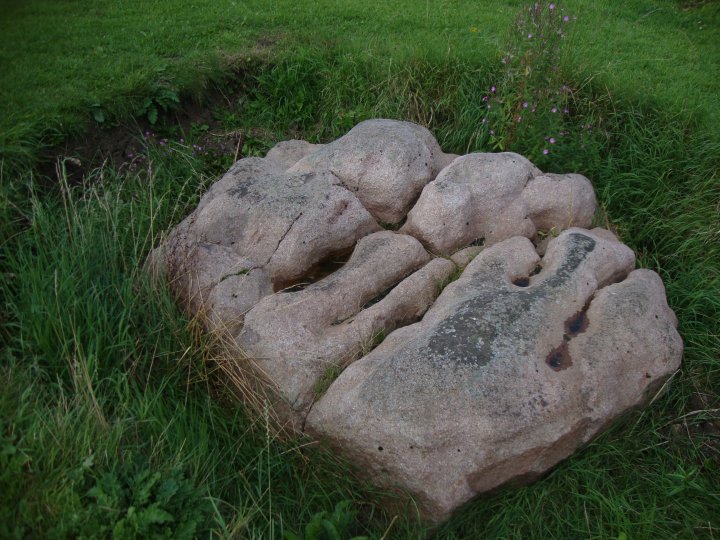


 Maps / Plans / Diagrams:
 Artistic / Interpretive:
 Posted by Chance
 Posted by Rhiannon
 Posted by juamei
 Top of page