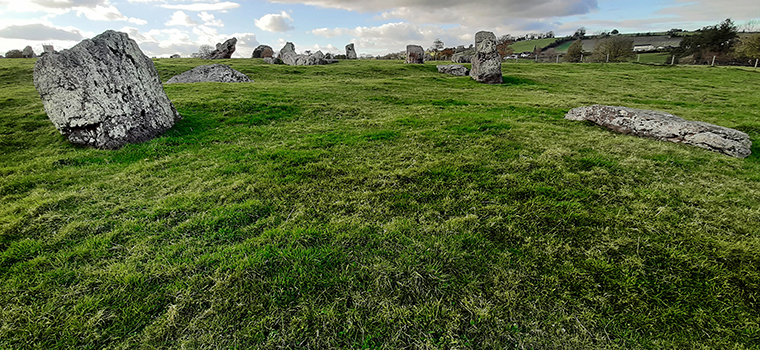
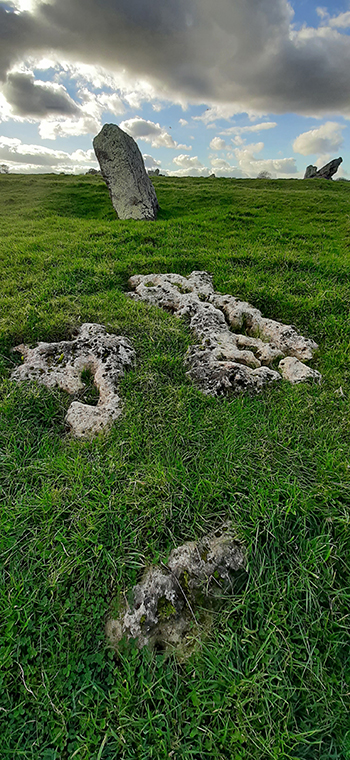
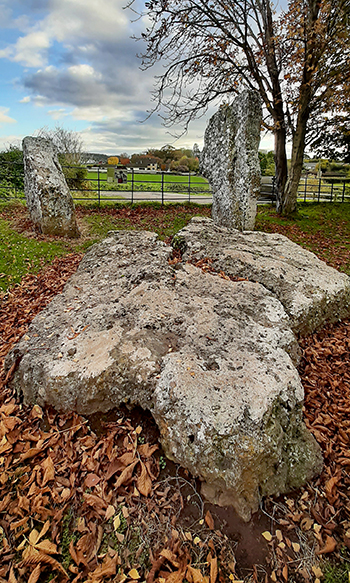
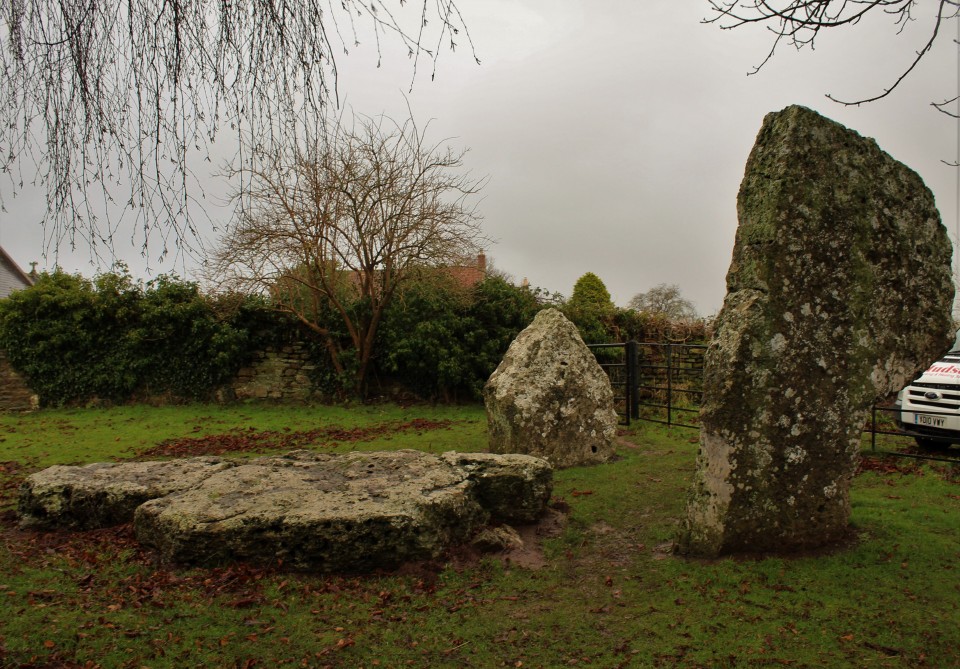
The interim report on this summer's geophysics work at Stanton Drew by the Bath and Camerton Archaeological Society is now ready. Stanton Drew is the third and least known of the Wessex threesome of major stone circles.
The formal report will follow, but these were the highlights... continues...
I visited on a dull, grey day and my mood didn't lighten when I realised that there were "ceremonies" being conducted within the circles. A group of women were being (for want of a better phrase) sprititually massaged by a middle aged man, whilst listening to "plink plink" music. Grrrrrr.....my issues with this kind of behaviour is that it makes the stones almost inaccessible for any other visitors. This was a Sunday morning (11am-ish) so I would assume it was pretty likely that others would want to visit at this time.
10 minutes later, a coach party of pensioners turned up but they were at least interested and I got a bit excited when I realised that Mike Parker Pearson was the tour guide! Once upon I time, I got excited when I met Michael Stipe; these days I'm an archaeology groupie!
I liked Stanton Drew but it felt a wee bit empty to me. Maybe it was the miserable weather but it didn't lift me in the usual way...maybe I ned to return and have a better experience?
Tuesday 16 September 2003 Access coming from the west, we took the B3130, turning right at the signpost for Stanton Drew. This junction is remarkable for a strange little cottage on an 'island'. One of the most bizarre domiciles I've ever seen - looks more than a little like a toadstool. Shame about the incongruous big brick chimney.
Driving into Stanton Drew, the circle is clearly signposted to the left. There's a small car park, and entrance to the field where the main circles stand is by a (kissing?) gate with an English Heritage honesty box.
And if you're lucky (we were) a little stock of b/w photocopied A4 single page info sheets. Nice touch but makes it annoying that they don't do it more often!
There's another kissing gate just before you reach the Great Circle. Looks bizarre because (at least at the moment) the only fence either side of it is a single string! This is not visible from more than a few yards away, so it just looks like a gate standing in a field!
The ground around the main and north-east circles is reasonably even, on a gentle slope.
Access to the south west circle is, from memory, over a stile and possibly through a gate too. Or 2 gates. Or 2 stiles. (Sorry!) The small field is also considerably less even and level.
Tuesday 16 September 2003
I'd been looking forward to this one for a very long time, since spotting it in Burl's ...Stone Circles of Britain, Ireland and Brittany - many years ago, not long after I got the book.
Despite having read quite a bit about it, the place still surprised me, particularly just through the sheer size of the Great Circle, and I guess, the cohesiveness of the whole 'complex'. Guess it's not ALL that often that you visit sites that are so distinctly and unavoidably inter-related. Shame about Hautville's Quoit....
Stanton Drew is a hidden gem, poorly signposted, just outside Bristol. The manner in which the site is presented hints at disagreement with ownership, a pathway being traced through obviously fenced land to the stones themselves.
Once we arrived nothing prepared me for the energy I felt. My dowsing rods twitched and soon I was aware of many lines of energy, the strongest appearing to run north to south.
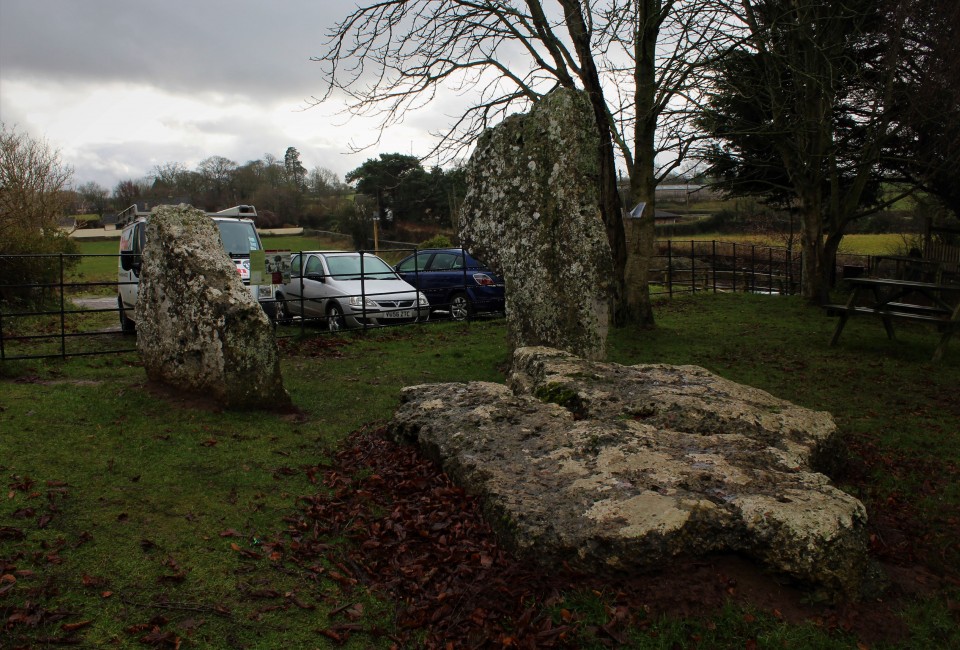
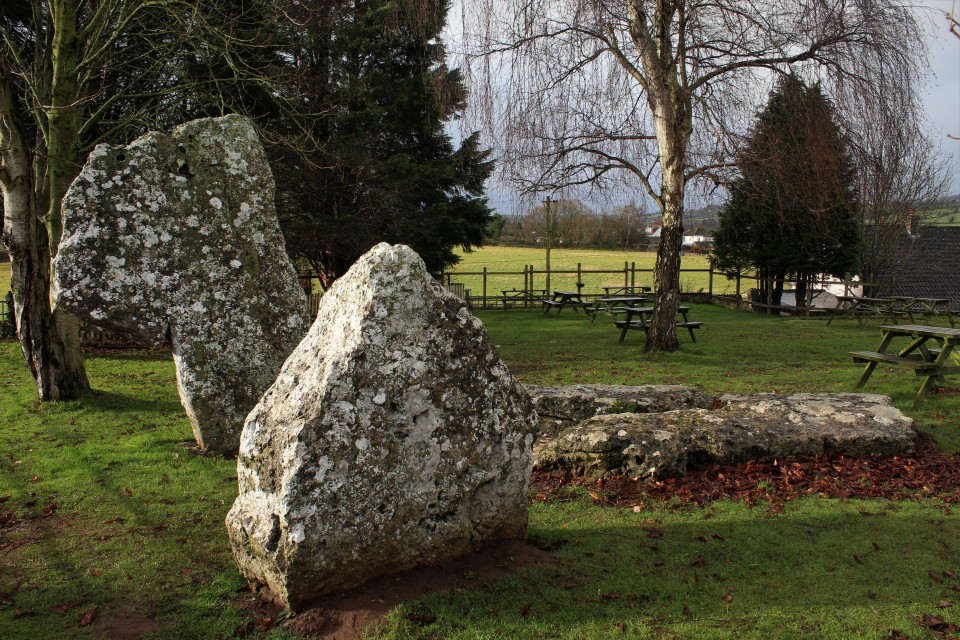
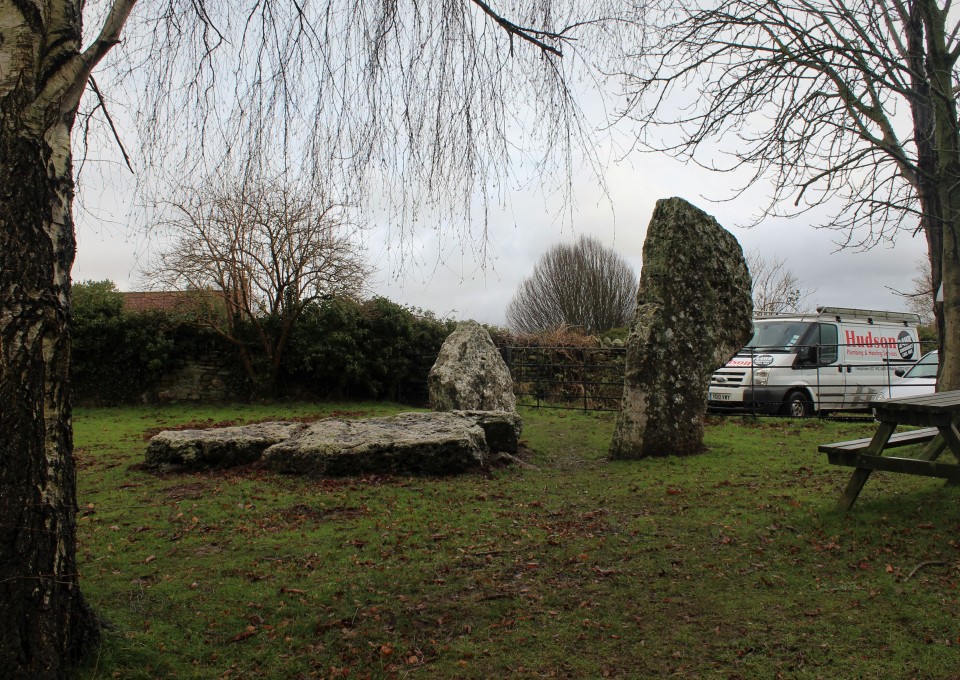
After half an hour or so we felt sufficiently adjusted to enjoy our lunch, and found ourselves at The Druids Inn, which has 3 large stones in the beer garden. Checking alignment, these reek of ceremonial purpose, and it was quite odd watching children caper amongst them.
We paid a final visit to Stanton after our repast, and still the energies were noticeable, so my dowsing powers were not affected by sub conscious sensation. I allowed another visitor to try my rods, and the result appeared to replicate what we had earlier found.
lack of excavation, a powerful location and a stunning location make this site well worth a visit. What hides beneath the surface and in the stones can only be guessed at, but local folklore hints at the darker side of human nature.
Ooh la la - Stanton Drew is a hidden gem. Dunno why I ain't been here before. Its size takes your breath away. I arrived on a mid-summers evening - and not a soul was around.
It really is a mind fuck. The third largest circle in the UK, traces of a large wooden structure buried beneath the surface and little research done. I guess its overshadowed by Avebury et all. Which is bad - but bad meaning good...a total lack of other visitors really gave me time to soak in the stunning lush agricultural views and breath the place in.
If you're thinking of visiting - take a picnic ... oh yeah and check out the Cove (coven?) in the beer garden of the nearby Druids Arms.
A magical place that rivals Stannon ring on Bodmin Moor for sheer ambience.
Such a large site, it's difficult to get a proper perspective – at least at Avebury you can climb a bank and see much of the circle laid out in front of you.
What I got here was a feeling of a large circle for 'proper' ritual, accompanied by a 'training' circle for the neophytes. No idea if this is how it was actually used, just a strong feeling I got.
It seemed to me too that the stones were made of the same rock as at the Rollrights – all eaten away and crumbly.
A real survivor, big and bold, but like an old war horse, badly scarred and needing nurture. Despite being such a big complex - three circles! - it didn't get me going. It felt broken and somehow bereft. My state of mind perhaps? The stones are massive, impressive with highly worked flat surfaces, and as big as the monsters at Avebury. Impressively rose-coloured with peppermint lichen, the sun cast great dark shadows and allowed the spring green of the grass to sing. I made a sketch but came away feeling sad. Up at the Cove, by the church, conveniently situated in the garden of the Druid's Arms, a monumental stone of the weirdest shape defies gravity and bends over to the left. I leave feeling sad.
Wowee... this place is SERIOUS. Comparing this place to most of the circles I've seen is like comparing a punk rock gig to a chamber music concert. The stones are just wild - amazing browny-orange hues that look like crouching animals. I'm not sure I'd even dare to come here on a full moon - you could almost hear the power crackling away even on a grey Sunday afternoon.
All the more amazing because of the picture-postcard English village setting... imagine taking tea at the vicar's and he gets out his collection of shrunken heads to show you - that kind of vibe.
A huge site, that gives you some idea (scale wise) of what might have been at Avebury. I visited alone, had a good couple of hours to myself, then watched the sunset from the smaller circle.
Pagan Hill nearby gives it's name to one of the country lanes. What an address!
Wow, this place is huge!
First visit yesterday, with only 20 mins daylight left, and we'll definitely return. Theres loads to take in, and you could definitely spend a day here.
The stones are very green (lichen), and although fallen, most stones are still in place, which really helps to visualise the site as it was.
One of Englands top sites, and as it says below-nobody comes!
First time at stanton drew. windy place. not as tourist friendly as the likes of your avebury etc, but hey, espesh dig the bouncing lambs in the farmers paddock ting by the entrance.
The second largest stone circle in Britain, 8 miles from the City and yet no one goes there... A quiet spot by the river with three (count 'em) circles, two avenues and outlying stones: a variation on Avebury, but nobody goes... The largest timber circle in the country and a Cove in a pub beer garden and nobody goes.... It IS lovely though.
What Bob down the pub was telling tourists in 1861. They deserved it, for their 'gaping rustic' remark.
Local intellect is undoubtedly highly mystified as to these relics. The children of the hamlet don't play at "hide and seek" about them after dark, and if public-house oracles are infallible, groans, &c. are not unfrequently to be heard in the stone-close, "when the moon is out," towards the sma' hours. One gaping rustic told us, "as how some do zay that it's a wedding, and that the fiddlers and the bride and groom were all petrified as they went to church." Now this idea is probably a fable of the seventeenth century, when music always preceded a couple to church. Another old dame said, "Others do zay, nobody can't count 'em; certain 'tis a baker did try with loaves on each, and they never could come right. But there 'tis, some do zay one thing, and zum another, that there's no believing none of 'em." So we thought, reader, don't you? An intelligent old farmer told us he had seen men dig several yards down without getting to the foundation of one of these stones. ...
The following which is taken from John Wood's book A Description of Bath of 1765 describes the superstition that lay round the Wedding stones of Stanton Drew as seen by the local people. People being turned to stone, and also drinking from the stones, which is a slightly different aspect of the story.
John Wood had a weird and wonderful theory about Stanton Drew and Druids, that belongs elsewhere, but in writing his book he gave valuable information as to the the existence of the two Tyning stones, and another folklore story about Hakill the Giant who in good giant tradition threw The Coit from Maes Knoll, a hill situated west from Stanton Drew, which also encompasses Maes Knoll Hillfort and the great Wansdyke barrier which either divided two kingdoms in the late British Iron Age or was some form of defense. The work of giants perhaps recognised by our 18th century inhabitants but not rationalised as they are today!
Stanton Drew in the County of Somerset
That's where the Devil played at Sue's request,
They paid the price for dancing on a Sunday.
Now they are standing evermore at rest.
The Wedding Stones
"The remains of this model bear the name of The Wedding, from a tradition that as a woman was going to be married, she and the rest of the company were changed into the stones of which they consist "No one," says the Country People about Stantondrue, was ever able to reckon the "number of these metamorphosed Stones", or to take "a draught of them" or tho' several have attempted to do both, and proceeded till they were either struck dead upon the spot, or with such an illness as soon carried them off.
This was seriously told to me when I began to a Plan of them (the stones) on the 12th August 1740 to deter me from proceeding: And as a storm accidentally arose just after, and blew down part of a Great Tree near the body of the work, the people were then thoroughly satisfied that I had disturbed the Guardian Spirits of the metamorphosed Stones, and from thence great pains were taken to convince me of the Impiety of intent I was about.
Hakim's Quoit
Large flat stone called Hakill on the north-east side of the river by which Stantondrue is situated: And this stone tho' greatly delapidated is till ten feet long, six feet broad, near two feet thick, and lies about 1860 feet from the centre of the circle.
....Now if we draw a line from the centre of the Circle D, to the centre of the Circle B and produce it westward 992 feet, it will terminate on three stones in a garden (Druid Arms now) by the parish church of Stantondrue: two of which stones are erect, and the other lies flat on the ground............. it will terminate on two stone lying flat on the ground in a field call the Lower-Tining (stones now vanished).
In plowing the ground of Maes Knoll as well as that of Solsbury Hill, the people frequently turned up burnt stones, and often find other Marks to prove each Place to have been long inhabited: the former, according to a Tradition among the people of the Country thereabouts, was the Residence of one Hakill, a Giant, who is reported to have toss'd the Coit that make part of the works of Stantondrue from the Top of that Hill to the place where it now lies: He is also reported to have made Maes-Knoll Tump with one spadeful of Earth, and to had the village underneath that Hill given him......
The 'wedding stones' story is found at other stone circles, the wedding taking place on a Saturday and lasting through the night into Sunday, when they were all turned to stone by the piper/harper, or in this case the 'devil'. The christian church again concocting a story to stop people enjoying themselves, one wonders where this story originally came into the history timeline.
Funnily in these tales caught from the past about Stanton Drew there is no 'drinking stone' myth whereby they would have gone down to the river Chew and refreshed themselves.
Much in former times has been written on their miraculous origin, and still superstition has not entirely died out, for a native told Prof. Lloyd Morgan that if he hit the stones with his hammer he would smell the brimstone.
Lloyd Morgan was professor of psychology at Bristol University. He 'spoke to the natives' on a field trip c1887.
From the Somerset Arch. Soc. Proc. (Bath Branch) for 1906.
The Reverend John Collinson mentions of the stones "it is an impiety to attempt reckoning their number."
Blimey, can't even count them without offending God, apparently. I suppose it's because a good Christian shouldn't associate him or herself with such superstitious nonsense.
'History and Antiquities of the County of Somerset' (c1780)
John Wood (the one who designed Bath's Crescent) wrote in 1750:
"No one, say the country people about Stantondrue, was ever able to reckon the number of the metaphosed stones, or to take a draught of them, though several have attempted to do both, and proceeded till they were either struck dead upon the spot, or with such an illness as soon carried them off."
When he tried to count them (why oh why, considering the warning) a cloudburst followed.
(quoted by J and C Bord in 'Prehistoric Britain from the air')
Aubrey visited Stanton Drew in the summer of 1664, but was unable to reach the stones because the field was full of ripening corn. He recorded that many of the stones had been removed and smashed during the previous few years by farmers covetous of extra land.
Leslie Grinsell suggests this explains 'the remarkable circumstance' of the lack of barrows in the area: that there may have been some but were ploughed out.
(in Grinsell's 'Archaeology of Wessex')
As the name of this page suggests, it contains a colourful version of the story behind the 'Weddings' name. It also has some photos, a description of the site and a diagram of the wood henge discovered by English Heritage in 1997.
Taken from Aubrey Burl's book "John Aubrey & Stone Circles".
(As a 12 year old John Aubrey spent time playing around Stanton Drew)
The chaos told the young Aubrey nothing.
Village gossip offered explanations. Some slabs were so ponderous that no man could have raised them. They were the work of giants. The name of one of them was known, Hackwell. He had been so strong that he had thrown an immensely heavy stone from a distant hill and it landed over a mile away on that ridge on the skyline just above the circles. There were rumours claiming Hackwell was so famous that he was buried in the nearby church at Chew Magna.
Others added a warning. The boy should never try to count the stones. It was impossible anyway because of the jumble but if anyone did reach the right number that person would suffer great misfortune, maybe even death for interfering in what was best left alone.
Another superstition relates how, on the sixth day of the full moon, at midnight, the stones walk down to the river to take a drink. But the best known whimsy, probably celebrated from Puritan pulpits as justifiable punishment for profaning the Sabbath, was that the stones were the petrified remains of a wedding party that had sinned.
A fiddler and his accompanists had played merry jigs for the dancers until Saturday midnight when, of course, the merry-making had to stop before Sunday began. Defiantly, the young bride refused to abandon her pleasure. She, her husband and all their guests would dance on. Midnight came.
The fiddler vanished. The Devil flashed, flared into the night. Everyone, bride, groom, parson, dancers, musicians, all of them instantly became stones wherever they were. And there they remain.
Superstitiously apprehensive locals told Aubrey that the sinners were still to be seen. Three stones by the church were the solidified bride, groom and parson. In the fields the rings were the rigid remnants of the dancers. The avenues were the tumbled lines of musicians.
The tale-tellers said that the fate of those wicked merry makers had been observed that dreadful night by horrified bystanders and had been remembered ever since in this neighbourhood.
“That a Bride goeing to be married, she and the rest of the company were metamorphos’d into these stones: but whether it were true or not they told me they could not tell.”
Reminiscing years later John Aubrey mused:
“I know that some will nauseate these old fables; but I do professe to regard to regard them as the most considerable pieces of [‘observable’ inserted] of Antiquity’ …. After all, was not Lot’s wife turned turned into a pillar of salt”
It would be almost another thirty years before he was experienced enough to see the devilish stones with a more sceptical archaeological eye. He was living in a superstitious world.
To me Stanton Drew is one of the best and one of the worst stone circles in Britain, on the one hand the stones are massive colourful giants gnarled with ages unguessed, and theres not just one circle but three, and not just three circles but a cove too, but...
On the other hand more than half the stones are pushed over perhaps into pits dug to recieve them, so now they barely poke through the grass,
and the Great circle is almost too big to take it in as a whole circle, the passage from the big field to the south west circle was muddy last time (the kind of mud that stinks and melts wellies), this time it was bovine rush hour . The south west circle is loads different in character to the other two, it occupies a small hillock and the stones are smaller.
Although there may be two hands, a visit to Stanton drew is always worth the long drive (unless you live in Bristol) and one I will continue to make, news of the cove being part of a longbarrow and a lost henge surrounding the stones, just makes the place all the more interesting.