Showing 1-20 of 34 news posts. Most recent first | Next 20 
Polissoir discovered!
An extremely rare and important stone artefact dating back over 5,000 years has been discovered during a community heritage project in West Dorset.
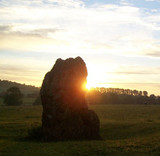
The natural stone boulder has a dished glossy surface where it was used to polish stone axe heads over 5,000 years ago. It has been discovered in the Valley of Stones National Nature Reserve in the Dorset Area of Outstanding Natural Beauty (AONB), near Dorchester.
In addition to being on a Site of Special Scientific Interest (SSSI), the polishing boulder is located within an area protected as a scheduled monument.
The polishing boulder – known as a polissoir - is formed of sarsen stone, a particularly hard form of sandstone known as silcrete (a cemented mass of sand and gravel), that was used during the Neolithic period for building monuments such as Stonehenge.
https://dorchester.nub.news/news/local-news/rare-stone-age-artefact-discovered-at-nature-reserve-near-bridport-191192
|
Spot the Hunter-Gatherers!
https://www.facebook.com/events/2128530017175633/
Got a spare day between Tuesday 6 and Sunday 11 March 2018?
Join our survey team and help find Spodden Valley's ancient hunting camps. Lancashire has one of the highest concentrations of hunter-gatherer sites in Europe. 8,000 years ago, it was prime territory. Today, it still bristles with the remains of ancient hunting camps... if you know where to look.
In March the DigVentures team are heading to Spodden Valley to help us begin a MASSIVE survey of its hunter-gatherer sites, and we are going to need LOADS of people. Together, we'll sweep across the valley looking for clues, but it's only a few weeks away and we need to assemble our team FAST
|
Developer plans to move London Stone out of WH Smith and onto public plinth
http://www.standard.co.uk/news/london/developer-plans-to-move-london-stone-out-of-wh-smith-and-onto-public-plinth-a3200061.html
In legend, it formed part of London’s foundations and was the resting place of King Arthur’s sword Excalibur.
But for years the London Stone has lain in a case behind a pavement-level grille in the Cannon Street WH Smith.
Now, the Grade II listed lump of oolitic limestone is set to be restored as a centrepiece of the Square Mile.
It ended up in the Sixties block housing WH Smith after its former berth, St Swithin’s Church, was bombed in the Blitz.
Under plans to turn the block into an eight-storey office tower, developer Applegarth has revealed plans to give the stone pride of place on a plinth.
An application to the City of London Corporation says: “The plinth and the London Stone would be reinstated at the height they were in St Swithin’s Church prior to its destruction in the Second World War. This would make it more prominent to public viewing than is currently the case.”
Giles Clapp, clerk of the Worshipful Company of Masons, which helps protect the history of the City of London, said: “We support giving the stone the prominence it deserves. It is very important in the telling of the London story.”
The relic — also known as the Stone of Brutus after the legendary Roman founder of the capital — is mentioned in historical documents as early as 1100.
It was written about by Shakespeare and Dickens and has become the subject of countless myths, including claims it was the stone from which Arthur drew Excalibur.
The 17th-century poet William Blake believed the site of the relic was a druidic sacrificial stone circle, while another theory holds it was the symbolic point from which all distances in Roman Britain were measured.
An application by developers Minerva to move the stone into the foyer of nearby offices sparked a row with heritage groups in 2012. The latest plan has been broadly welcomed, with Historic England raising no objections.
The CLC has called the new proposal “an appropriate development”. Its ruling, after a meeting tonight, could have wider repercussions for the City. An ancient warning comes with the block, which says: “So long as the Stone of Brutus is safe, so long will London flourish.”
|
Stone ball stolen from dunblane museum
A bronze age carved stone ball, measuring approx. 6cm by 6cm has been stolen from its display cabinet at the Dunblane Museum, The Cross, Dunblane, sometime between early and mid November, 2015.
The stone ball may have some identifying numbers marked on it however it would be possible for these to be removed. A photo of the stolen stone ball is attached.
Dunblane Officers are investigating the theft and are appealing for information. If you have any knowledge of who may be responsible or know the whereabouts of the stone ball, please contact them on 101 or via Crimestoppers on 0800 555 111.
https://m.facebook.com/ForthValleyPoliceDivision/photos/pb.162735270431066.-2207520000.1452715137./952907308080521/
|
Caerau under threat – Mrs Angry Writes
[....]
I was up at the hill fort only recently. It’s still so lovely up there but obviously, since the trees are now without their leaves, it is possible to see the Ely Link Road. And, surprise surprise, you can see the solar farm.
Now, and this is the bit that is really making me rather very angry, I have learned – via social media – that we are now going to have – guess what ? OK, that’s unfair, how could you know – I didn’t – a LANDFILL SITE. Yes, that’s correct. Now, this is not your black bag rubbish type tip, this is an ‘inert waste’ tip. What exactly does ‘inert waste’ mean? So, for the next 5 to 6 years up to 20 lorries, very quickly, in a dust raising, dirty and frankly quite dangerous manner will be driving along Cwrt yr Ala Road. That lovely quiet tree lined but slightly narrow road.
I’m really pleased to be able to say that the local Labour Councillor for the area is doing his level best to stop this happening. Indeed the Welsh Lib Dem AM for South Wales Central and spokesperson on Enterprise, Transport, Europe and Business has assured me that she will ‘look into it’ but in the meantime the Vale of Glamorgan has, in their recent report on this completely outrageous planning application – available online and therefore well within the public domain – given me the opportunity to give you some quotes. In fairness I suggest you check this out for yourselves but, in the meantime here are a couple of my favourites:
The site is located in open countryside and within the Cwrt yr Ala basin Special Landscape Area as defined within the Unitary Development Plan. The site also lies within the boundaries of the derelict mineral site, the former Ely Brickworks. In addition it is noted that the Caerau Wood hill fort, which is a Scheduled Ancient Monument, is located to the north of the site within the neighbouring Cardiff Council Local authority area.
and;
In terms of impact upon Vale residents this would be very limited as there is no residential development, within the Vale, close to the proposed site. With regard to impact upon Cardiff residents, and any significant effect on the environment by virtue of the nature, size and location of the development this is a decision for the Local Planning Authority (LPA)
https://sebrooke.wordpress.com/2016/01/08/caerau-under-threat/ and reblogged here https://heritageaction.wordpress.com/2016/01/13/caerau-under-threat/?utm_source=dlvr.it&utm_medium=facebook
|
A matter of trust: New excavation
This week I will be opening up a trial trench to examine a prehistoric site, on the fringe of Glasgow, that was buried 51 years ago beneath a 1m layer of soil and turf.
The site is called the Cochno Stone and it is one of the most spectacular and extensive panels of prehistoric rock-art in Britain. It is located in the lower reaches of the Kilpatrick Hills, in an area with dense rock-art concentrations on small outcrops and boulders.
In 1964 it was sealed, put beyond use and rendered inaccessible.
By archaeologists.
For its own good.
This rock-art splattered outcrop, rich with cups, cup-and-rings marks, spirals and two four-toed footprints was deemed, in the 1960s, to be under threat from the urban expansion of Glasgow. The Council-built estate of Faifley, now in West Dunbartonshire Council, encroached almost to the Cochno Stone itself. Too close apparently.
Houses were built. Infrastructure was constructed. Power towers and electricity cables were added.
Continues here:
https://theurbanprehistorian.wordpress.com/2015/09/05/a-matter-of-trust/
|
Short tunnel for A303??
The deputy Prime Minister has just said he wants the Government to sanction plans to rebuild the A303 before the next election. Since the 3 options just published for the Stonehenge section consist of 2 versions of a short tunnel plus an unrealistic northern bypass – and no long tunnel – it seems likely that what he is effectively pressing for is a short tunnel. As for the timing, he says he very much hopes we can see “diggers in the ground” well before 2017/18.
Here are a couple of questions about what’s some would see as a looming World Heritage Scandal:
First, we previously wrote to English Heritage asking what they meant when they said they’d argue for the tunnel “with all our strength” - a long one or a short one? In April they replied:
“It is not possible to comment on this, or provide documentation that supports a decision regarding which scheme English Heritage would support, for the simple reason that we have not yet been presented with scheme options to advise upon. When DfT presents us with their potential scheme options, then we will be able to advise upon their heritage impacts and relative merits.”
Well, the options have now been published (sans a “long tunnel”) and the Stonehenge Alliance, for one, has made a formal response. Will English Heritage now clarify their position and will they, like the Stonehenge Alliance has done, call for the “long tunnel” option to be reinstated as an option on the grounds that the other options are hugely damaging to the World Heritage Site they are charged with protecting?
http://heritageaction.wordpress.com/2014/10/13/has-nick-clegg-become-the-latest-supporter-of-a-short-tunnel-at-stonehenge/
|
Review of Rewriting the (Pre) history of Ulster - Dr Rowan McLaughlin
This is a write-up of a talk given by Dr Rowan McLaughlin regarding how the 4000+ developer produced RC dates since 2001 in Ireland basically rewrite whole swathes of how we perceive the prehistory of Ireland.
http://rmchapple.blogspot.co.uk/2014/06/review-rewriting-pre-history-of-ulster.html
[snippet from 1/3 of way in]
Over the last decade-and-a-half or so has seen a vast increase in the volume of archaeological data that has been produced. Much of this is the result of economic circumstances, where development-led excavations have been carried out in advance of construction. Many of these were carried out during the Celtic Tiger years, in advance of major infrastructural works such as roads, pipelines, quarries, and residential developments. In a perfect world, the excavations get written up and get stored in archives as ‘grey literature’ ... some even get published. McLaughlin estimates that over the last ten years alone some one million pages of new data for the island of Ireland have been written down. Rowan’s approach to the ‘data mountain’ has been centred on extracting an understanding of chronology from this mass of data, a task he describes as ‘the golden cord to lead out of the labyrinth’. An examination of all the available radiocarbon dates for Irish prehistory that were available in around 2001, shows that there were 1396 known from both published and grey literature sources. Plotting all of these out gives an indication of what prehistory is ‘like’ at this point. As may be expected, there are relatively few sites dating to the earliest periods and more sites from more recent times and a slow but gradual increase in between. This has led to a view of the prehistory of Ireland where there was an initial colonisation during the Mesolithic (c.10k cal BP) and that this was a relatively stable hunter-gatherer way of life until the introduction of agriculture (c.6k cal BP). After this point we see a population explosion that goes hand in hand with increasing social and religious complexities. From this point on we can witness communities evolving and adapting these beliefs and practices, until it reaches its final developed flourishing of civilization in more recent times. As he says: ‘The problem with that view is that it is entirely wrong. It’s not what the archaeological data actually indicate.’ He sees that this discovery has been the big achievement of development led/commercial archaeology in Ireland since the millennium. He then turned to another histogram of 4928 dates from prehistoric Ireland that have become available in the time since 2001.Instead of a gradual increase, there are peaks and troughs in activity. At some times it appears that there were significant episodes of large-scale archaeological deposition, and this contrasts with periods of seemingly little activity. To understand the reality of what we’re seeing here, there are a number of ideas that must be kept in mind. Firstly, all the dates must be calibrated as we cannot directly compare this archaeological data with environmental evidence from various regions. The other issue is the degree of bias in how these data points were collected. Obviously, the first bias is where excavations take place – either dictated by individuals’ research interests, or where development is planned. Further biases exist in the systematic approach that archaeologists use in the collection of this data. For example, there are certain types of features that are more likely to be dated over others – what McLaughlin describes as features that are ‘more juicy looking’ and, thus, more likely to be dated. Indeed, certain types of sites are almost completely ignored and this is an ongoing issue.
|
BBC - Nine Ladies stone circle daubed with paint
http://www.bbc.co.uk/news/uk-england-derbyshire-26629162
A stone circle believed to have been built 4,000 years ago has been vandalised.
Residents living near the Nine Ladies stone circle near Stanton Moor in the Peak District found the stones had been painted over the weekend.
The ancient monument dates back to the Bronze Age and is popular with walkers and pagan worshippers.
English Heritage said it was working with the local authority and police to investigate the damage.
Walkers spotted the stones had been painted yellow and green.
Nine Ladies vandalism
Each of the stones were drawn on with green and yellow paint
Anna Tattler, who lives nearby, said: "It is atrocious. It is a really special place and used for people to come and spend quiet, contemplative time here.
"It is a real shame the vandals have not recognised their importance and to deface them like that is pretty awful."
In 2000, environmental protesters had camped at the site in a long-running campaign against plans to reopen two dormant quarries near the monument.
Permission for the planning application was eventually revoked in 2008.
An English Heritage spokesman said the site may need specialist conservation work to remove the paint in order to avoid further damage.
He added: "Please don't try to remove the paint yourself as it could cause further damage."
|
Brecon beacons rock art found - volunteers wanted
http://breconbeacons.wordpress.com/2014/03/06/first-prehistoric-rock-art-discovered-in-the-brecon-beacons/
Very similar to the beeb story posted yesterday which I suspect was based on this. With the following at the end which may be of interest to some:
The National Trust’s Council for British Archaeology Community Archaeologist, Charlie Enright will be arranging a number of archaeological and survey days in the area in the coming weeks. He added: “This is a fantastic opportunity to get local people involved in an exciting archaeological project. They’ll be working alongside and learning from professional archaeologists and other likeminded people, acquiring new skills and contributing to our understanding of this fantastic site. If people are interested then they should contact me straight away to book – places are limited!”
Volunteers will be undertaking a range of archaeological activities including:
Recording the stone with Dr George Nash.
Conducting a geophysical survey in the area surrounding the stone to see if we can find any evidence of past human activity below the surface.
Condition monitoring and a topographical survey of the surrounding archaeology.
If you are interested in taking part – places are limited so please book by contacting Charlie Enright, Community Archaeologist at the National Trust, at: [email protected]
|
Help wanted to create 3D modeling of megalithic sites
http://heritagetogether.org/?lang=en
"HeritageTogether is an AHRC-funded project run by Bangor, Aberystwyth and Manchester Metropolitan Universities in conjunction with Gwynedd Archaeological Trust. Our aim is to use photographs of our heritage to create 3D models using a process called photogrammetry. We want to create an online library of our heritage, preserved digitally and accessible to everyone.
The project aims to provide new information about megalithic sites and their locations using 3D digital models, which can be generated from digital photographs.
The project aims to incorporate research by members of the public; we hope people will contribute to the project by uploading digital photographs of sites that they visit. Provided that the photos are taken in the correct way, from the images that people load up, we will be able to generate 3D models.
The “citizen science” aspect of the project will allow us to produce 3D models from a wide range of monuments from across North Wales. We hope that this way of gathering data will help us produce a representative (and perhaps comprehensice) catalogue of the heritage of North Wales, provide new research into the state of monument preservation, provide new views of monuments, and provide new evidence for monument use (in the form of rock art for example).
At the end of the project, the 3D models will be freely and publicly available to provide a research resource for members of the public and researchers, though the Historic Environment Record and via the Archwilio platform.
We will acknowledge the contributions of all individuals to the project, and contributors will be invited to the project exhibition, which will present the 3D modelling results. At the exhibition we will acknowledge a number of citizen scientists who we feel have made outstanding contributions to the project. "
|
English Heritage update on the Priddy repairs
PRIDDY CIRCLE 1 – STATEMENT ON ARCHAEOLOGICAL MITIGATION AND REINSTATEMENT
BACKGROUND
In May 2011, large-scale unauthorised damage took place on one of the four Priddy Circles, a group of large, circular earthworks of prehistoric date which are protected as Scheduled Monuments. In October 2012, following a prosecution brought by English Heritage, the owner of Priddy Circle 1, Mr Penny, pleaded guilty to carrying out the unauthorised works. He agreed to pay for repairs to the monument and other mitigation works at a cost of around £38,000. He was also fined £2,500 by Taunton Crown Court and ordered to pay costs of £7,500.
The circle is designated and protected under the Ancient Monuments & Archaeological Areas Act 1979 and under this legislation it is a criminal offence to undertake works to a Scheduled Monument without the consent of the Secretary State (known as Scheduled Monument Consent).
In addition to a substantial fine and costs, Mr Penny signed a Voluntary Agreement committing him to funding a package of ‘reinstatement’ works, the detail of which was to be approved by English Heritage. Although we argued that some archaeological investigation should be an important part of an overall package of restorative justice works, the court was clear that the focus of the work funded by Mr Penny should be on aspects of physical reinstatement as opposed to archaeological investigation of the damaged areas.
ENGLISH HERITAGE PRESS STATEMENT
Given the national and international significance of the Priddy Circles, English Heritage felt it important that the damage caused to the monument should not be repaired without some archaeological investigation taking place. Therefore, a programme archaeological work was designed by English Heritage, focusing on the parts of the monument that had been either been damaged or disturbed. The work was commissioned to run alongside the evaluation phase of the reinstatement works, which was necessary to inform decisions on whether to restore areas of the circle that had been subject to earthmoving.
Over Spring and Summer of this year, English Heritage, together with archaeological contractors AC Archaeology, undertook a programme of assessment and evaluation, including a geophysical survey of the damaged parts of the site. The results of this work helped in the design of an archaeological excavation which was carried out in September and October 2013, and focused on an area of deep wheel-rutting caused by the creation of a track way through the site during the unauthorised works.
The fieldwork is now completed and post-excavation analysis and recording are currently underway, including the use of specialist scientific dating techniques by English Heritage at our laboratory in Portsmouth. The results will be published in due course, and it is hoped they will advance our knowledge and understanding of this rare and early monument type, in addition to helping inform management decisions for the Priddy Circles and similar monuments elsewhere.
The final part of the reinstatement works is due to take place early in the New Year, when some reconstruction of the bulldozed circle bank will take place. This is a limited piece of work with two objectives – firstly, to restore some of the form and legibility of the circle and secondly to cover over and protect important Neolithic archaeology which had been left exposed by the damage. When this work is completed, Mr Penny’s obligations under the Voluntary Agreement will have been met and the Scheduled Monument will once again be in a stable condition for posterity.
(from http://heritageaction.wordpress.com/2014/01/09/finally-priddy-good-news/)
|
Drowned Landscapes exhibition at Royal Society 3 - 8th July
A huge area of land which was swallowed up into the North Sea thousands of years ago has been recreated and put on display by scientists.
Doggerland was an area between Northern Scotland, Denmark and the Channel Islands. It was believed to have been home to tens of thousands of people before it disappeared underwater. Now its history has been pieced together by artefacts recovered from the seabed and displayed in London. The 15-year-project has involved St Andrews, Dundee and Aberdeen universities.
The results are on display at the Royal Society Summer Science Exhibition in London until 8 July.
http://sse.royalsociety.org/2012/exhibits/drowned-landscapes/
more at
http://www.bbc.co.uk/news/uk-scotland-edinburgh-east-fife-18687504
|
Watch the Transit of Venus from Mam Tor
On 6th June there will be a very rare astronomical event: a transit of the planet Venus across the face of the Sun. The last transit of Venus occurred on June 8th in 2004, and the next one visible from the UK will occur on 8th December 2125 (although there is another transit in 2117 which won't be visible from the UK). The 2012 transit of Venus will be in progress by the time the Sun rises in the UK at 4:50am, and will be over by 5:55am. This means that only the very final stages of the transit will be visible from the UK, weather permitting.
The National Trust has given permission for representatives of the Peak District National Park Authority's Dark Skies project to observe the 2012 transit of Venus from the summit of Mam Tor. Several astronomers will be on hand from 4:30am with telescopes and special glasses to allow members of the public, weather permitting, to view the transit of Venus.
http://peakdistrictnt.blogspot.co.uk/2012/05/mam-tor-and-transit-of-venus.html
|
Mike PItts reviewing the Heelstone - Pit news
Let's have a dispassionate look at the latest Stonehenge news. The Stonehenge Hidden Landscape Project (University of Birmingham and the Ludwig Boltzmann Institute for Archaeological Prospection) continues its geophysical survey. So what's new?
The press release is titled "Discoveries provide evidence of a celestial procession at Stonehenge", which is pretty much what all the journalists who reported it said (often just copying the release). It includes a "podflash" interview with Vince Gaffney, and there is a video visualisation of the theory here.
The Independent really went to town, using words like "extraordinary" and "massive", suggesting the discoveries might "turn the accepted chronology of the Stonehenge landscape on its head", and that "Stonehenge site's sacred status is at least 500 years older than previously thought". The project as a whole is going to "transform scholars' understanding of the famous monument's origins, history and meaning". Golly.
I couldn't see where all this came from, so I contacted the Birmingham University press office, who very kindly gave me these geophysics plots. As no other news media anywhere as far as I can see has used them, I thought it would be helpful to post them here. Then we can see what is being talked about.
I mostly leave it to others to look at these plots and comment on the interpretations (please do). What I will do here is describe what Birmingham team found, and add a bit of context.
They pick on two geophysical anomalies, which they call pits, just south of the northern line of the Cursus:
Click through to see the pics
http://mikepitts.wordpress.com/2011/11/29/view-from-the-heelstone/
|
BACAS Geofiz survey finds possible circle
Those helpful guys at BACAS have done a survey on the suspected site of the destroyed circle up on Bathhampton down and found what looks like post holes.
Worth noting this is a mile to the west on the other side of the hill from the stones pictured.
http://www.bacas.org.uk/geophysics/BathamptonDownScreenVersion.pdf
|
Mass burial suggests massacre at Iron Age hill fort
Archaeologists have found evidence of a massacre linked to Iron Age warfare at a hill fort in Derbyshire.
A burial site contained only women and children - the first segregated burial of this kind from Iron Age Britain.
Nine skeletons were discovered in a section of ditch around the fort at Fin Cop in the Peak District.
Scientists believe "perhaps hundreds more skeletons" could be buried in the ditch, only a small part of which has been excavated so far.
Construction of the hill fort has been dated to some time between 440BC and 390BC, but it was destroyed before completion.
The fort's stone wall was broken apart and the rubble used to fill the 400m perimeter ditch, where the skeletons were found.
A second, outer wall and ditch had been started but not finished.
http://www.bbc.co.uk/news/science-environment-13082240
|
Oldest evidence of arrows found
Researchers in South Africa have revealed the earliest direct evidence of human-made arrows.
The scientists unearthed 64,000 year-old "stone points", which they say were probably arrow heads.
Closer inspection of the ancient weapons revealed remnants of blood and bone that provided clues about how they were used.
http://www.bbc.co.uk/news/science-environment-11086110
|
Cyclist attacked by men and dog on Hackpen Hill
An 18-year-old cyclist suffered severe facial injuries after being attacked by three men and bitten by their dog.
The teenager was riding up Hackpen Hill near Broad Hinton, Wiltshire, on Sunday afternoon when he stopped at the top to have a cigarette.
Police said three men in their 40s approached him and punched and kicked him. Their dog, described as large and brown, then bit his arm and face.
The men stole his mountain bike before running off towards a nearby car park.
http://news.bbc.co.uk/1/hi/england/gloucestershire/7604018.stm
|
Showing 1-20 of 34 news posts. Most recent first | Next 20 |
Rumours I found one folklore piece to complete my rainbow are true
|
 Log in |
Register
Log in |
Register

 Top of page