|
 Log in |
Register Log in |
Register
|

|
|

Tolvan Holed StoneHoled Stone
|
||||||||||||||||||||||||


 0 discussions


 Show map (inline Google Map)
|
|
|
Images (click to view fullsize) |
 Add an image Add an image |
Photographs: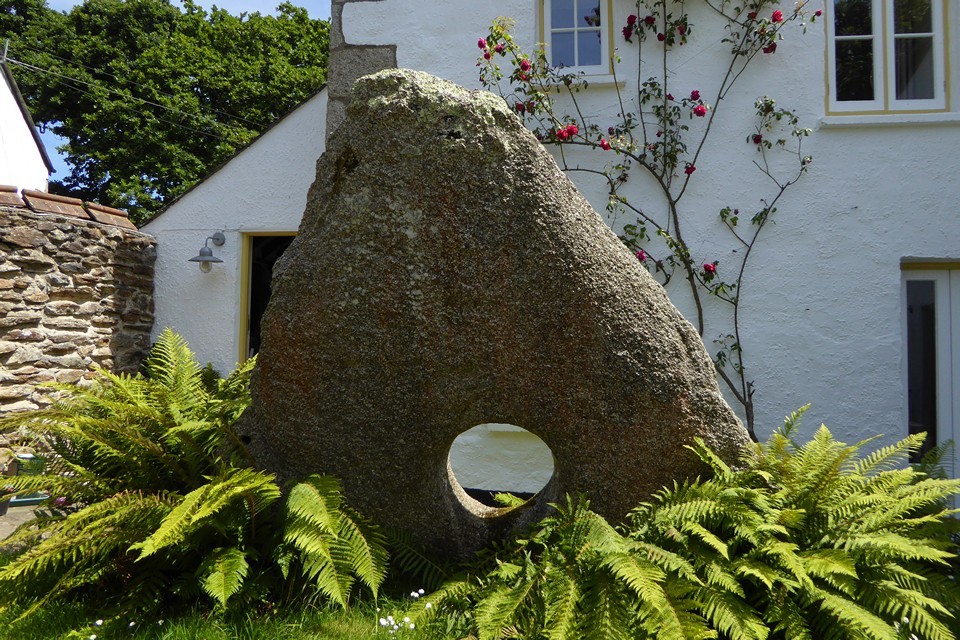
 Artistic / Interpretive: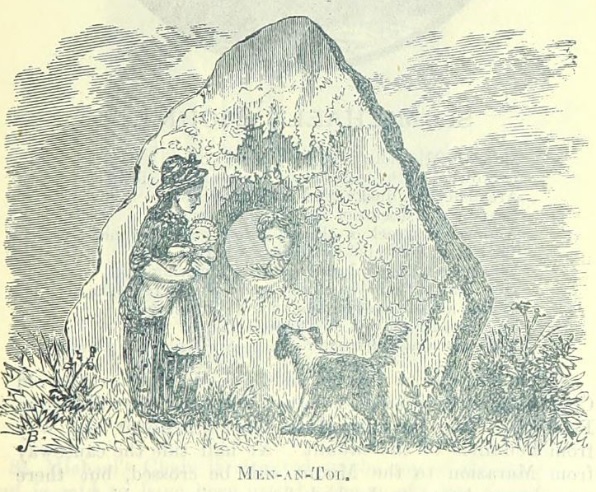
|
Fieldnotes |
Add fieldnotes |
|
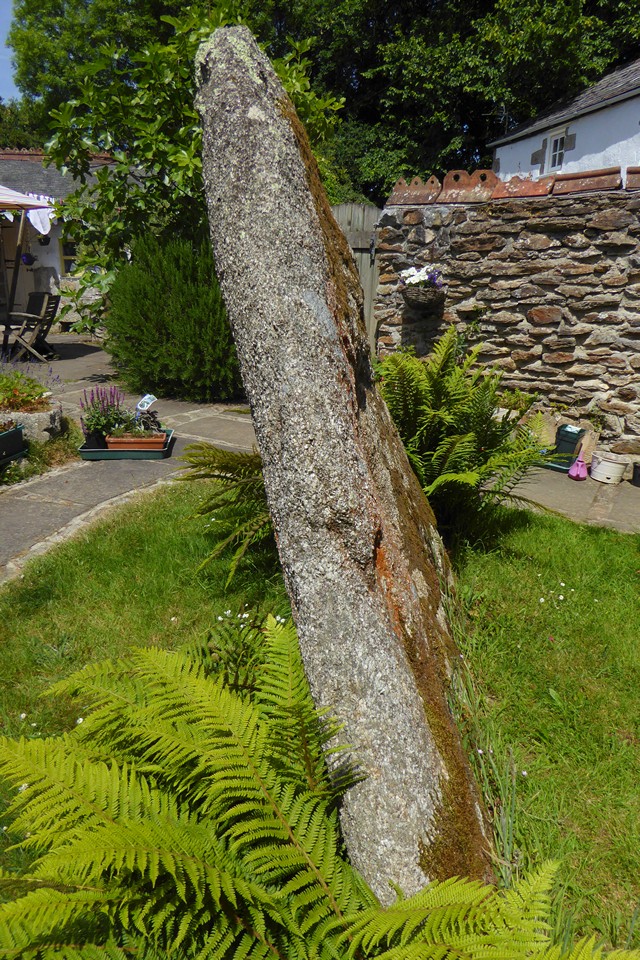
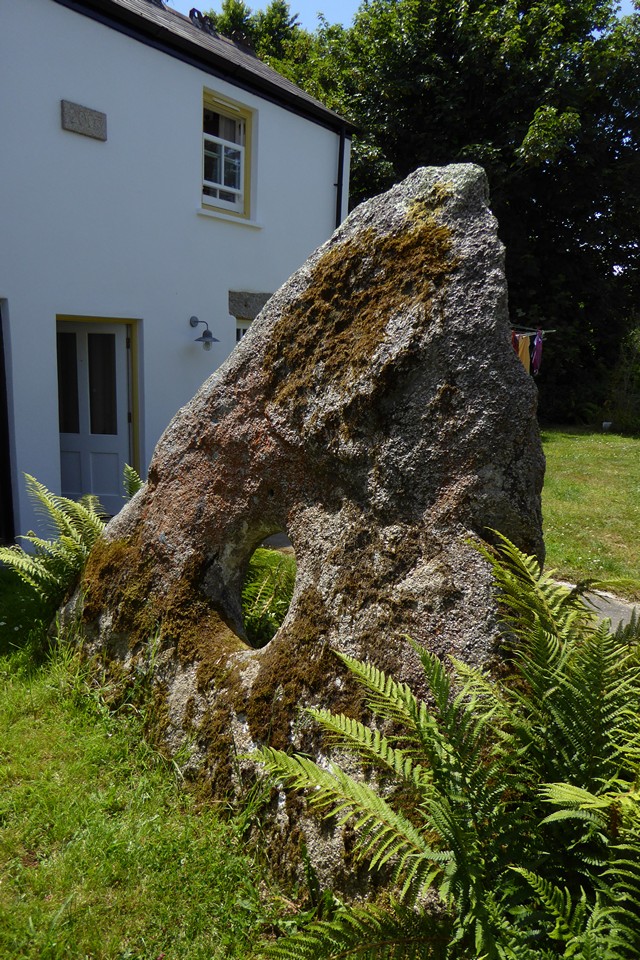
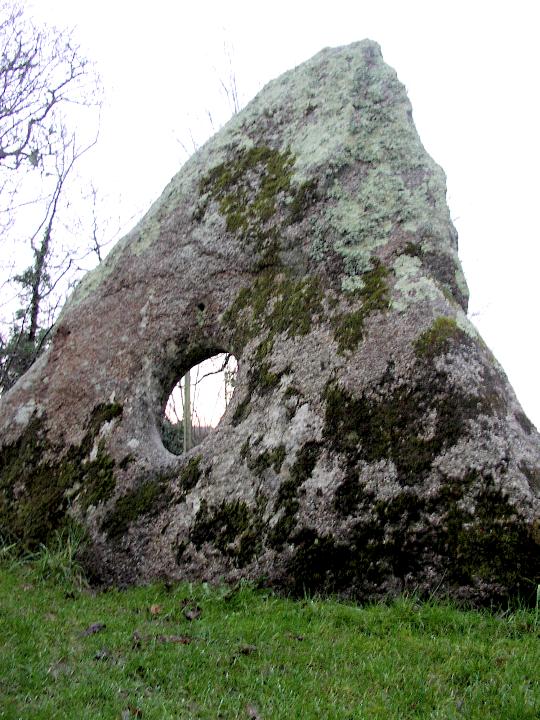
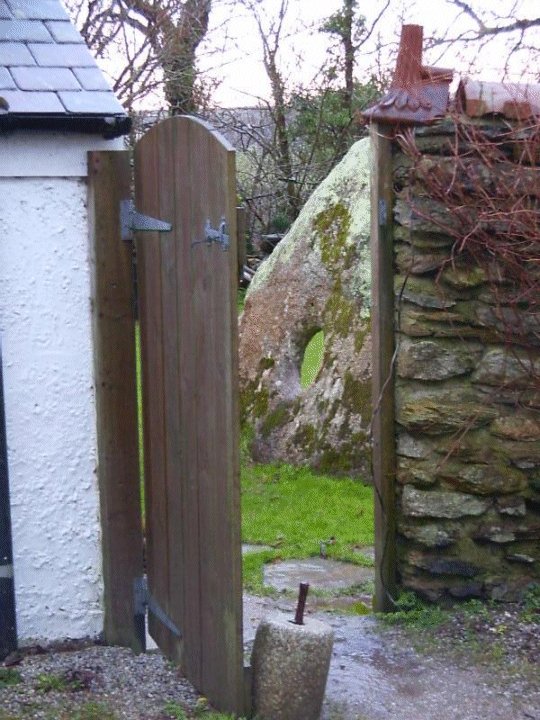
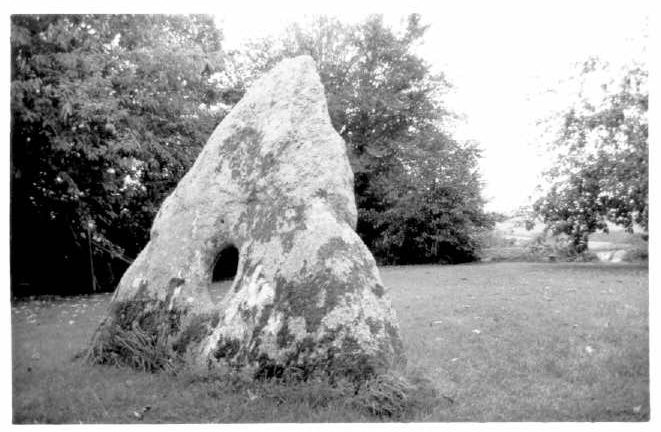
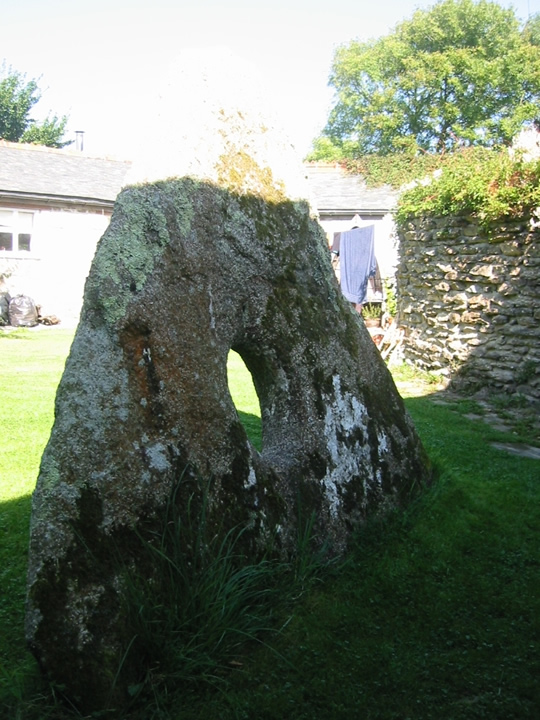
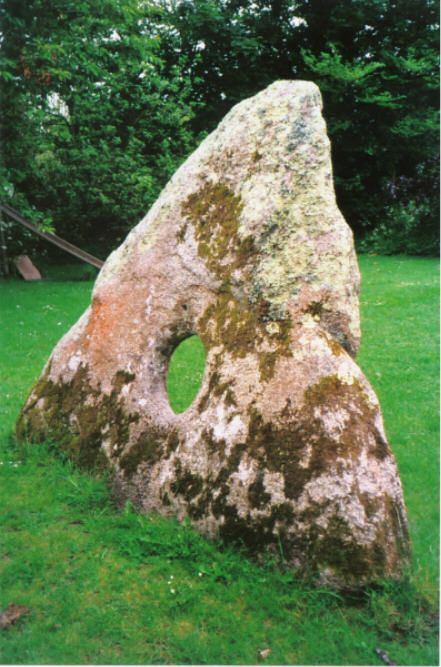
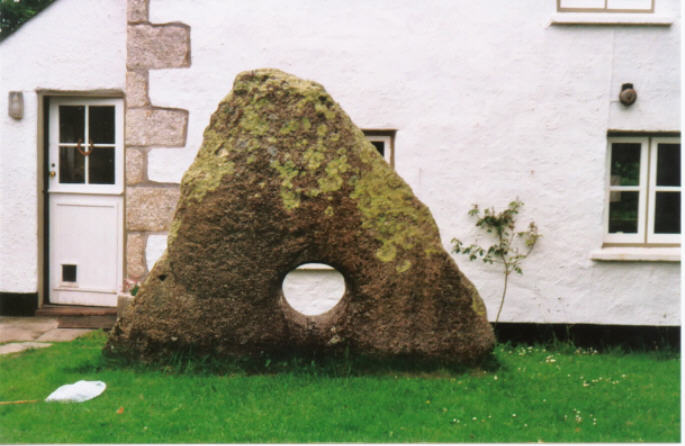
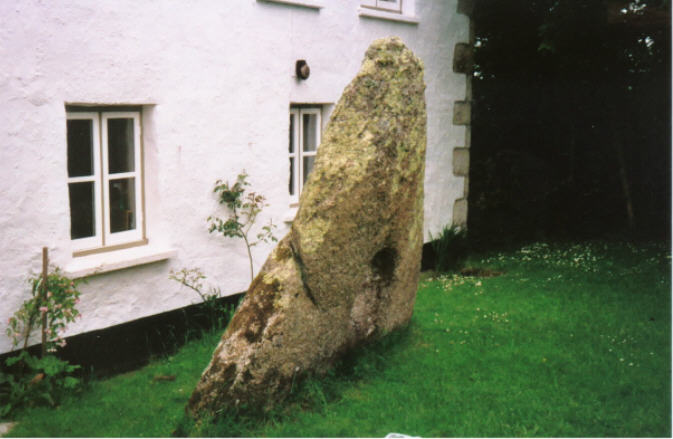
A huge, flat triangular single stone about 8' tall at the apex with a bloody great round hole carved in it, stands in the back garden of cottage. But not in the middle of the garden, oh no, it's just 6' away from the back door! How it wasn't moved or trashed when the white-washed cottage was built in the mid 19th century is a mystery. Weird and wonderful and I want one, too! |
 Posted by Jane
24th March 2004ce |

|
Popped in here on the way to the Lizard Peninsula for wells, fogous and the such. Was a bit wary of knocking, despite plenty of people saying the owners of the cottage are happy to let you see it! I'm terrible for access if I even get an inkling it's private, but this is a bit blatant! You can see it from the little back road but it's not the same... ;o) We heard someone in the garden so knocked at the gate (couldn't see how to get in any other way anyhoo!) There was a lovely lady there on her tea break (she was decorating for the owners, who were not there) and she let us in. Must be my winning smile... The stone is probably the weirdest that I've seen! It's leaning quite a bit, and triangular... You can see that from the pictures, though... But it's a lot bigger than I expected. It was stone cold on a lovely summery day, and damp. It seems to be almost perpetually in the shade of the cottage. Who'd build a cottage so close to this lovely stone? It's a shame, but nice that the owners/decorators are so welcoming to visitors. Very nice stone. Wonder what it meant? |
 Posted by goffik
15th October 2003ce |
|
The Tolvan - 1st October 2003 Just as cool as expected, although I always manage to build up pictures of places in my head and they are never quite the same. I don't know why but I didn't quite expect the road the cottage is on to be a country lane, or to be next to the rolling countryside. The area is also surprisingly close to the water (The Helford River is barely 1km away). Just in case you didn't know the Tolvan is situated in the back garden of Tolvan Cross Cottage, which is 800m north of Gweek. From Gweek, the main road bends slightly right, whereas the road for the Tolvan is straight on as you get to the Spar / Post Office. The current owners are a lovely young couple, and although they obviously retain the right for people to view at their discretion, they are very flexible and don't mind people turning up unannounced. Or you can, as I did, give some prior warning in case they are out, away etc. They get about 5-6 people a year at the moment, and unless those number rise dramatically they don't see it as a problem at all. The stone is all I expected. Big and enigmatic. One thing that I hadn't noticed on pics was a small circular hole on the left hand side. Wonder what that is all about? NB - their 'front door' is at the back, next to the stone. This post appears as part of the weblog entry Kernow again - Part 2 - Land of the Giants
|
 Posted by pure joy
7th October 2003ce Edited 7th October 2003ce |
| Don't be afraid to knock on the door to see this strange stone, the present owner of the house and guardian of the stone is only too willing to show it and tell you about it. You can only see it from the garden which is behind the cottage. |
 Posted by hamish
1st June 2003ce Edited 2nd June 2003ce |
Folklore |
Add folklore |
I have shown (in the Antiquary for April, 1912) why the Tolven Stone was set up on edge, and although this was done as recently as the middle of the nineteenth century, it had long ago acquired a reputation as a "crick-stone."From Correspondence in 'The Antiquary' v10 (April 1914), our correspondent being George J Beesley. The reputation had to have been developed after it was put up, because otherwise, how would you shove infants through it? Or is he conceding that it already had the reputation (suggesting it had already been standing at some point)? |
 Posted by Rhiannon
4th May 2016ce Edited 5th May 2016ce |

I was told that some remarkable cures had been effected [at the Holed Stone at St. Constantine] only a few weeks since. The ceremony consists of passing the child nine times through the hole, alternately from one side to the other; and it is essential to success that the operation should finish on that side where there is a little grassy mound, recently made, on which the patient must sleep, with a six-pence under his head. A trough-like stone, called the 'cradle', on the eastern side of the barrow, was formerly used for this purpose. This stone, unfortunately, has long been destroyed. That holed stones were not originally constructed for the observance of this peculiar custom is evident, for in some instances the holes are not more than five or six inches in diameter.From Traditions and Hearthside Stories of West Cornwall by William Bottrell (1873). |
Posted by Rhiannon 20th November 2012ce |
|
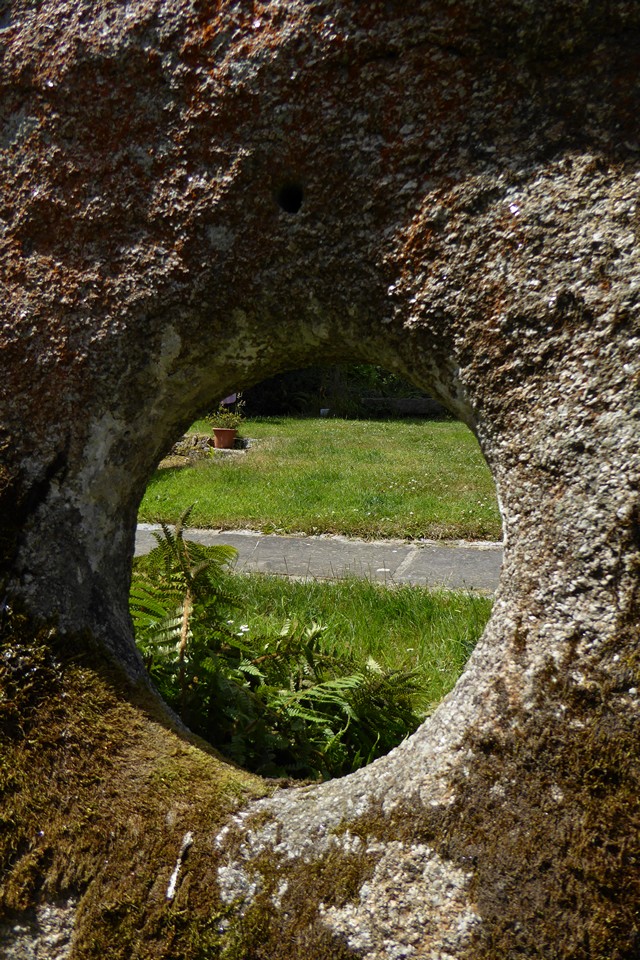
"As far as I know there is only one other stone beside the Men-an-Tol through which one squeezes as a specific, this being the Tolven stone at the back of a farm in the Helford River area, sited on a ridgeway which is crossed by an ancient track to Helston. Here the result being insured being fertility, I feel certain that the prerequisite of nudity also applies. It is a rock pierced by a round hole through which one can just wriggle, the whole performance being plainly a birth symbol." Ithell Colquhoun - :The Living Stones of Cornwall" (1952) |
 Posted by chris s
7th December 2007ce |
| Said to ensure fertility, particularly to newly married couples, but only after they have squeezed their naked bodies through the hole. |
Posted by pure joy 12th February 2003ce |
| In 1885 it was recorded in living memory that this stone was used for curing infirm children by passing them through the hole. |
Posted by phil 6th December 2001ce |
Miscellaneous |
Add miscellaneous |
...I propose to give a few hitherto unpublished particulars [of the Tolven stone]. It stands at the back of a small farmhouse in Tolven (or Tolvan) Cross, about half a mile from Gweek, on the road from Helston to Truro, and just at the intersection of that road, with a less important one connecting Constantine and Wendron.One can't help thinking that the weirdness of the stone is the reason people walking on the ancient roads crossed at that spot (because it was an interesting and obvious landmark). But I'm not sure Mr Beesley would go for this theory. His theory is that the holed Men-An-Tol and this stone are holed because they're cross bases. That's a big stone to pick for a cross base though, you have to admit. He says I therefore leave my case in the hands of my readers, who, if they cannot accept my solution of the mystery, will, I feel sure, be tolerant. Ah if only there'd been the TMA Forum in those days. But no, you had to go and find a goose for a quill and boil up some ink, write it in your best handwriting and pop your exasperated response in the post. By which time you probably did feel quite tolerant. Ah they'd have loved the forum wouldn't they. From 'What is the Men-an-tol?' by George J Beesley, in The Antiquary 8 (April 1912) |
Posted by Rhiannon 4th May 2016ce Edited 7th May 2016ce |

|
Details of site on Pastscape Holed stone, pit, barrow: possibly remains of a cist/burial chamber (SW) 70632770(1) The Tolvan, the largest holed stone in Cornwall, measured 8ft 6ins high by 8ft 11ins wide at the base, and about 1ft thick. The hole s 17ins in diameter (2) (see illustration) A cottage was built on the site in 1847 and the stone was moved to its present position, built into the yard fence behind the cottage. At this time several pieces were cut off the Tolvan, to make gateposts, so that it now measures 7ft 9ins high 7ft 7ins wide at the base. (3) A few years before 1864 while digging close to the Tolvan a pit was discovered in which were fragments of pottery arranged in circular order, and the whole covered with a flat sab (2) It has been suggested that the Tolvan is the remains of a burial chamber but G Daniel thinks this unlikely. (4) (SW) 70662772(1) About 80 yds away is the remains of a barrow 20 yards in diameter. 'A trough-like stone called the 'Cradle' on the eastern side of the barrow has long since been destroyed. (1-4) At the original site of the stone there was a five foot diameter pit lined with spar-stones; this was the cist or grave and the stone the last surviving side-stone of a mighty Quoit or Dolmen. It gave its name to the whole estate of Tolvean, properly Tol-vean or 'Holed-stone'. The survey of 1649 refers to a part of Tolvean called Main-toll (ie Holed-stone) Down and mentions the 'Main-toll great stone'. The 'Tolvan Stone' at SW 70622770 can hardly be other than prehistoric. The somewhat differing accounts of finds at the original site suggest contrived evidence but it is not clear why Dr Daniel should dismiss the possibility of a burial chamber. There is no trace of the barrow noted by Blight. (5-6) -------------------------------------------------------------------------------- SOURCE TEXT -------------------------------------------------------------------------------- ( 1) General reference CA 5 1966 80 (E Dowson) ( 2) General reference Arch Camb 3rd S 1864 293 (J T Blight) ( 3) General reference Hist Constantine 1937 8-9 illus (C Henderson) ( 4) General reference Prehist Chamb Tombs 1950 46 (G E Daniel) ( 5) General reference History of Constantine 1937 8-9 (C Henderson) ( 6) Field Investigators Comments F1 NVQ 29-OCT-71 |
 Posted by Chance
10th July 2012ce |
|
"An interesting idea but strange that nothing else like it exists elsewhere." Quoted by Pure Joy. I you thought might be interested in this: The Long Stone, Parish of Minchinhampton, Gloucestershire Folklore has attributed similar healing properties to the Long Stone in the Parish of Minchinhampton in Gloucestershire. Known locally as the "holey stone", this slab of oolitic limestone stands nearly 8 feet high with a thickness of about 18 inches. Believed to be the last surviving fragment of a long barrow chamber, the stone has two holes in it through the larger of which mothers would pass their children to cure them of whooping cough or rickets. Folklore also tells that the Long Stone runs around the field it is in when it hears the town clock in nearby Minchinhampton strike midnight. |
Posted by satmansmissus 27th August 2006ce Edited 28th August 2006ce |
|
JT Blight in a journal for the Royal Institute of Cornwall (1862) stated the Tolven was "formerly a conspicuous object by the way-side. In the past 12 or 14 years a house has been built betwixt it and the road. It now forms part of a garden hedge" He also wrote of a low barrow about 20 yards in diameter ina field adjoining the stone 18 yards across the road. Beside this was a kist which Blight refered to as a cradle used to place children in after they had been passed through the Tolven. Another reference to the Tolven is found in "The Cornishman" newspaper in 1879. Here it is stated that the stone originally lay on nearby Fean Downs but was considered unsafe. A Mr Moyles, whilst building a new house in 1847 had the stone moved to help form a hedge to his new property. Ignoring those that said it was bad luck to move the stone Mr Moyles then proceded to knock off portions of the top and bottom of the stone. This information was gained from an article in the 2001 Old Cornwall Society magazine by Michael Tangye. |
 Posted by Mr Hamhead
26th April 2004ce Edited 26th April 2004ce |
|
This is what Craig Weatherhill says in his book ‘Cornovia: Ancient Sites of Cornwall’ (Cornwall Books, 1985, revised 1997 & 2000): “In the back garden of Tolvan Cross Cottage, on a minor road 1mile due North of Gweek. Permission to view must be sought. A large upright slab, triangular in shape, 2.3m tall and 2.2m wide at the base. The centre of the stone is pierced by a circular hole 44cms in diameter, the purpose of which is unknown. It is probably Bronze Age.” Homer Sykes in ‘Mysterious Britain’ (Weidenfeld & Nicolson, 1993) says that it is unknown how far into the ground it stands, and that the hole is bevelled. He says that some suggest the Tolvan was used to block a now lost ancient burial chamber, and suggests that the hole allowed a way in for funeral purposes and a passage out for the spirits of the dead. An interesting idea but strange that nothing else like it exists elsewhere. |
Posted by pure joy 12th February 2003ce |
|
This stone is a Triangular 2.29 slab with a 4.44 m diameter hole placed 0.71 m from the ground. The weirdest stone you will find in Cornwall! It The stone is behind a cottage on a lane going due north from Gweek to Penryn. It happens to be in someone's back garden so permission is needed to veiw |
Posted by phil 6th December 2001ce Edited 24th March 2013ce |
 Top of page