|
 Log in |
Register Log in |
Register
|

|
|


Ladykirk StoneCarving
|


 Show map (inline Google Map)
|
|
|
Images (click to view fullsize) |
 Add an image Add an image |
|
Fieldnotes |
Add fieldnotes |
|
Visited 3.6.12 Well I did visit but the church door was locked and I couldn’t get the key as it was a Sunday. I tried looking through the windows but couldn’t see the stone. The church is right on the shoreline. I did have a look around the lovely old grave yard and admired the weather beaten old tombstones covered in the now familiar ‘hairy’ lichen. I do like an old church / graveyard with character. |
Posted by CARL 6th July 2012ce |

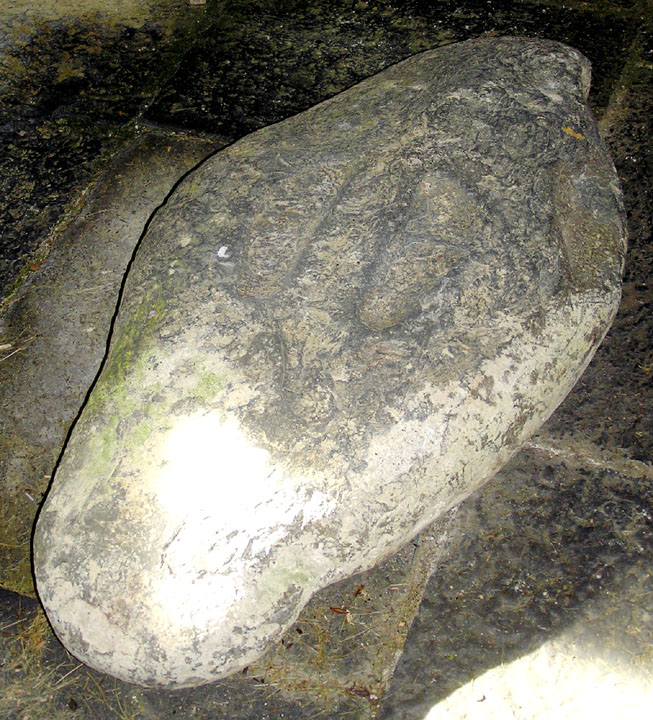
| This can be found in a church alongside the road to Burwick pier where the short sea ferry crossings take place in the tourist season). It is now in a back room at the church, and the key can be had from the lady who runs the local P.O. As this is on the 1:25,000 but unsignposted it is probably best to enquire at the Tomb of the Eagles in order to avoid disappointment outside of its limited post office hours. |
 Posted by wideford
9th April 2007ce |
Folklore |
Add folklore |
There is (or was), in Lady Kirk, at Burwick, South Ronaldsay, Orkney, a large stone which, according to the Rev. G. Low, tradition says St Magnus used as a boat to ferry him over the Pentland Firth, and for its service laid it up in the church, where it is still preserved.From F.W.L.Thomas's article on Dunadd in PSAS, Dec 1878. |
 Posted by Rhiannon
5th April 2015ce Edited 5th April 2015ce |

| Stone Hone, ND25NW 13 at ND24265736, by tradition is the grave of an Earl Liot(us) of Caithness and Orkney [Ljot Thorfinnsson]. |
Posted by wideford 25th May 2012ce Edited 25th May 2012ce |
|
Saint Magnus appears to come into the story sometime between the 16th century and 1690. Down in Caithness a story was told of the saint turning a dragon into the Stone Hone in the Watten parish, now reduced to rubble. The first mention is that a man was shipwrecked and got home by jumping on the back of a monster, which he then turned into the stone, this "Gallus" promising to dedicate a church to St. Mary. Although the writer wrote of the stone being by a 'temple' near the shore I presume this simply means the kirk. Between this time and 1701 it seems to have been reduced from 6'x4' to the present dimensions - perhaps this was to remove some pagan feature. By Gallus we might be dealing with another word for a RC priest - perhaps Magnus' name was attached to protect the stone at a time of religious upheaval. Of course as this saint was an earl of virtually kinglet status it could have been attached even earlier. |
Posted by wideford 3rd September 2004ce Edited 25th May 2012ce |
| The alternative name comes about because St.Magnus was held to have used it as a boat . |
Posted by wideford 27th February 2004ce |
Miscellaneous |
Add miscellaneous |
| Previous chapel is grassy mound between on banks of Burwick loch, between this and and shoreside road. X for St.Colm's Chapel shown on 1882 map at ND44168427. Originally occupied an islet in the now-drained loch so probably on a crannog/broch/island dun site. |
Posted by wideford 24th April 2006ce Edited 24th April 2006ce |

|
In the kirkyard of St.Mary's Church near the Burwick pier there is a water-worked whinstone with two hollows resembling feet . It has been suggested in the last few years that it is the inaugural stone of a sub-king with land in both South Ronaldsay and Caithness. |
Posted by wideford 27th February 2004ce Edited 10th September 2004ce |
 Top of page