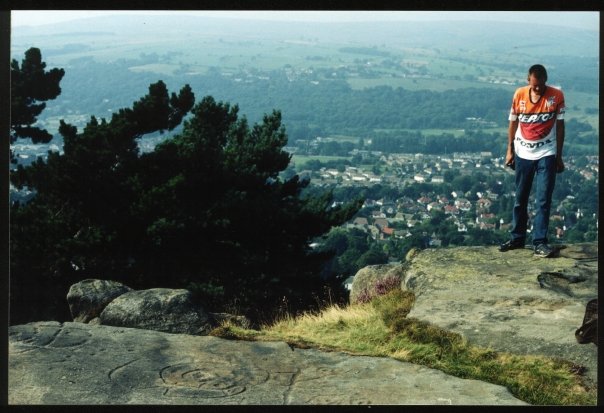
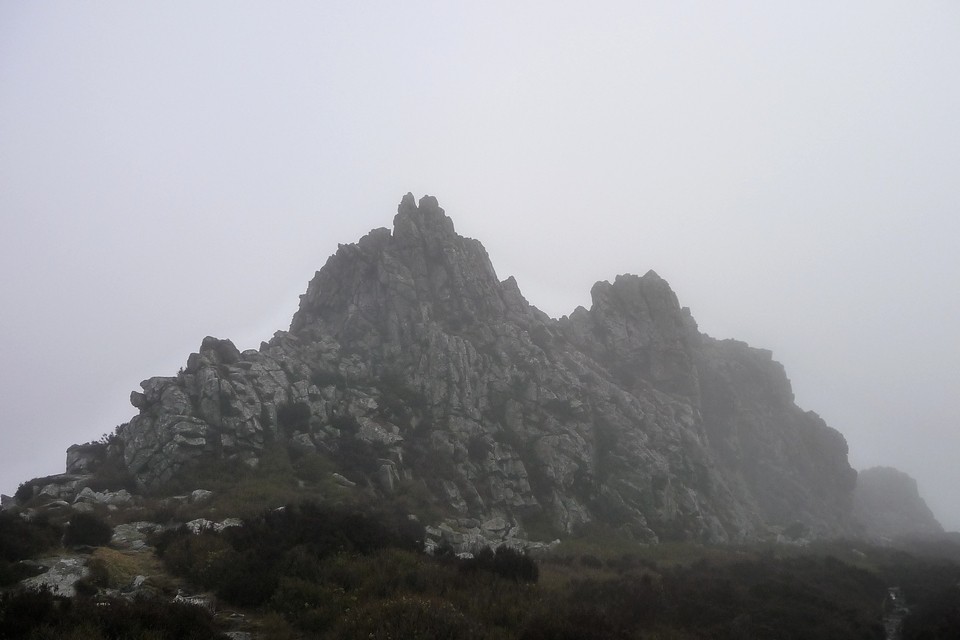
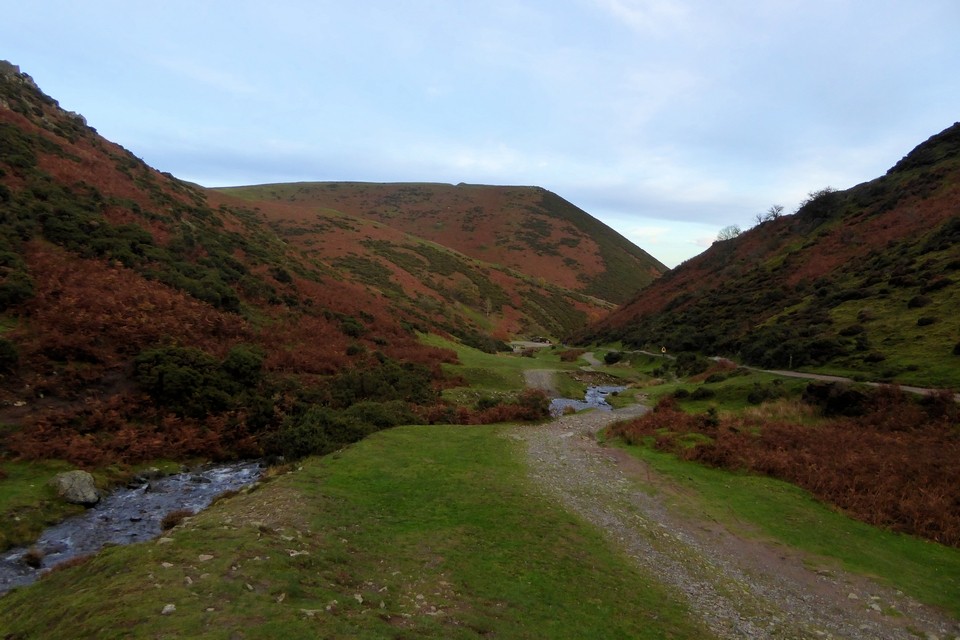
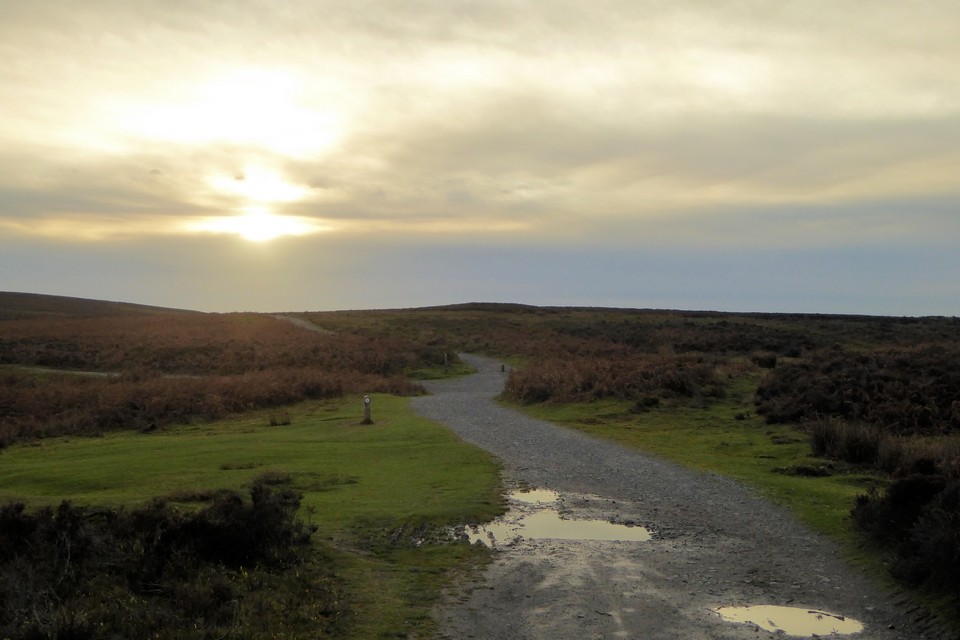
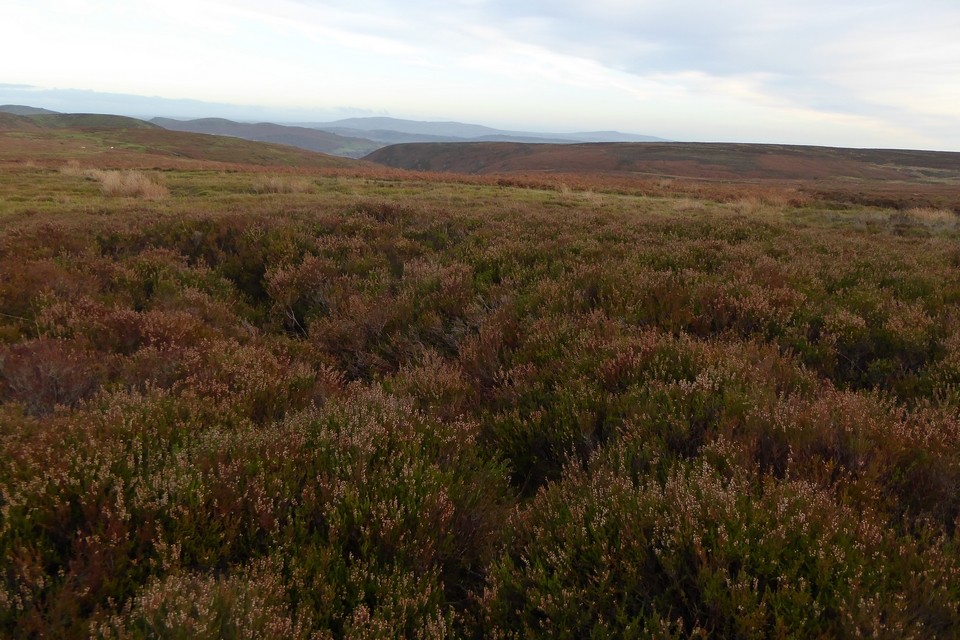
The hill Merryton Low forms the highest point of Morridge to the North-East of the Staffordshire Moorlands village of Thorncliffe. There are two barrows on Merryton Low, one on the summit and this second one to the South-West of the summit some 350m away.
Merryton Low II is obviously not as easy to locate as Merryton Low I simply because it has not got a concrete pillar on top of it! However, it is located just a short distance off to the right of the path that leads from the summit down the southern slopes of the hill. The top of the barrow is visible from the road that leads from The Mermaid Inn up to The Mermaid's Pool - but it is one of those that Ah! Yes, you can see it - but only after you have been up to it first and then return back down to the road.
The barrow has a somewhat flattened top with maximum dimensions of 12m by 11m in diameter and up to 0.8m high. This barrow has an unusually narrow aspect to it and is sub-oval in shape (almost cigar shaped in fact). The western tip of the barrow looks as if it is almost pointing finger-like at Bosley Cloud over on the Staffordshire-Cheshire border.
Merryton Low II is not known to have been excavated and is not thought to be one of the three barrows on Morridge mentioned by Plot (Plot, R. "A Natural History of the County of Stafford-shire" 1686. Ch.X. Para.19, Ch.X. Para.21.)
Merryton Low II does not appear on the OS Landranger or Explorer maps covering the area.
The hill Merryton Low forms the highest point of Morridge to the North-East of the Staffordshire Moorlands village of Thorncliffe. The summit of the hill is the meeting point of three parish boundaries: Onecote to the South, Fawfieldhead to the North-East and Heathylee to the North-West.
The name Merryton Low used to be 'Meriloneslowe' (13th-century spelling) denoting a barrow or hill (from the Old English Hlaw) by a boundary lane (from the Old English Gemaere lone). Source: VCH Staffs Vol.VII Leek and the Moorlands (1995) p.211.
Merryton Low I is a very easy site to locate as it sits at the southern end of the summit of the hill and has an OS Trig pillar at the South-West of the barrow's somewhat flattened summit. The western face of the OS Trig pillar has a memorial plaque upon it dedictaed to the 5th Staffs Leek Battalion Home Gueard 'C' Company. The parish boundary between Onecote C.P. and Fawfieldhead C.P. crosses directly over the barrow.
The barrow is oval in shape measuring 13m North to South, 12m East to West and up to 0.7m high.
Merryton Low I is visible from the road that leads from the Mermaid Inn up to Blake Mere (The Mermaid's Pool) and there is a track leading up to the site from the road. There is a similar track leading to the Mermaid's Pool just a short distance further along the road and this may be an easier place to park.
Merryton Low I is not thought to be one of the three barrows on Morridge mentioned in Plot.
(Plot, R. "A Natural History of the County of Stafford-shire', 1686. Ch.X Para.19, Ch.X Para.21).
Merryton Low I is clearly marked on OS Landranger 119 and OS Explorer OL24 by a Tumulus label and Earthwork symbol around the Trig Pillar symbol.
Roylow or Rye Low is a large mound which is recorded as a barrow of uncertain date located right next to the public footpath that leads from the Staffordshire Moorlands village of Sheen to the hamlet of Brund. This barrow is in very good condition and very accessible.
Thomas Bateman examined Roylow on 21st August 1849. He described the barrow as being 35 yards in diameter and "rather more than 9ft" in height. The earth of the mound was intermixed with charcoal and layers of moss near the natural surface level.
On 2nd October 1894 Mr. J.P. Sheldon of Sheen reopened Roylow "Situated between Sheen and the Brund, three quarters of a mile to the West". He descibed the barrow as circular, about 100ft in diameter and 8ft high in the centre. A trench from West to East through the barrow revealed the upper part was of loamy clay with a few pieces of fist-sized sandstone within it. Below this and about a foot from the natural surface there was at the commencement of the trench "a thin stratum of ferruginous earth more or less hardened by the action of fire", apparently continuous throughout the barrow.
Beneath this were at least two layers of sods laid in irregular courses. In the centre of the mound were layers and vein like ramifications of some kind of sedimentary matter, bright blue in colour. Below this in the central region was a pasty sort of clay about 1ft in thickness containing many white nodules which Sheldon concluded were fragments of bone in a soft decomposed state but he could not say if the remains were human.
Roylow survives as a large bowl-shaped mound 33.5m in diameter and 1.9m high with no visible ditch. A single, now quite large tree sits on top of the mound and appears to sit in a slight depression on the summit of the mound.
Roylow is marked on OS Landranger 119 and OS Explorer OL24 by a Tumulus label and Earthwork symbol.
We took the little lane from the A171 to the A174 going through to East Barnsby. Beautiful May morning, three fords to cross, Yorkshire at its best down in to deep old dark woods, with bluebells, wind anemones and ransom on the verge, tumbles of old trees and water, what more can you ask after all that cold weather.
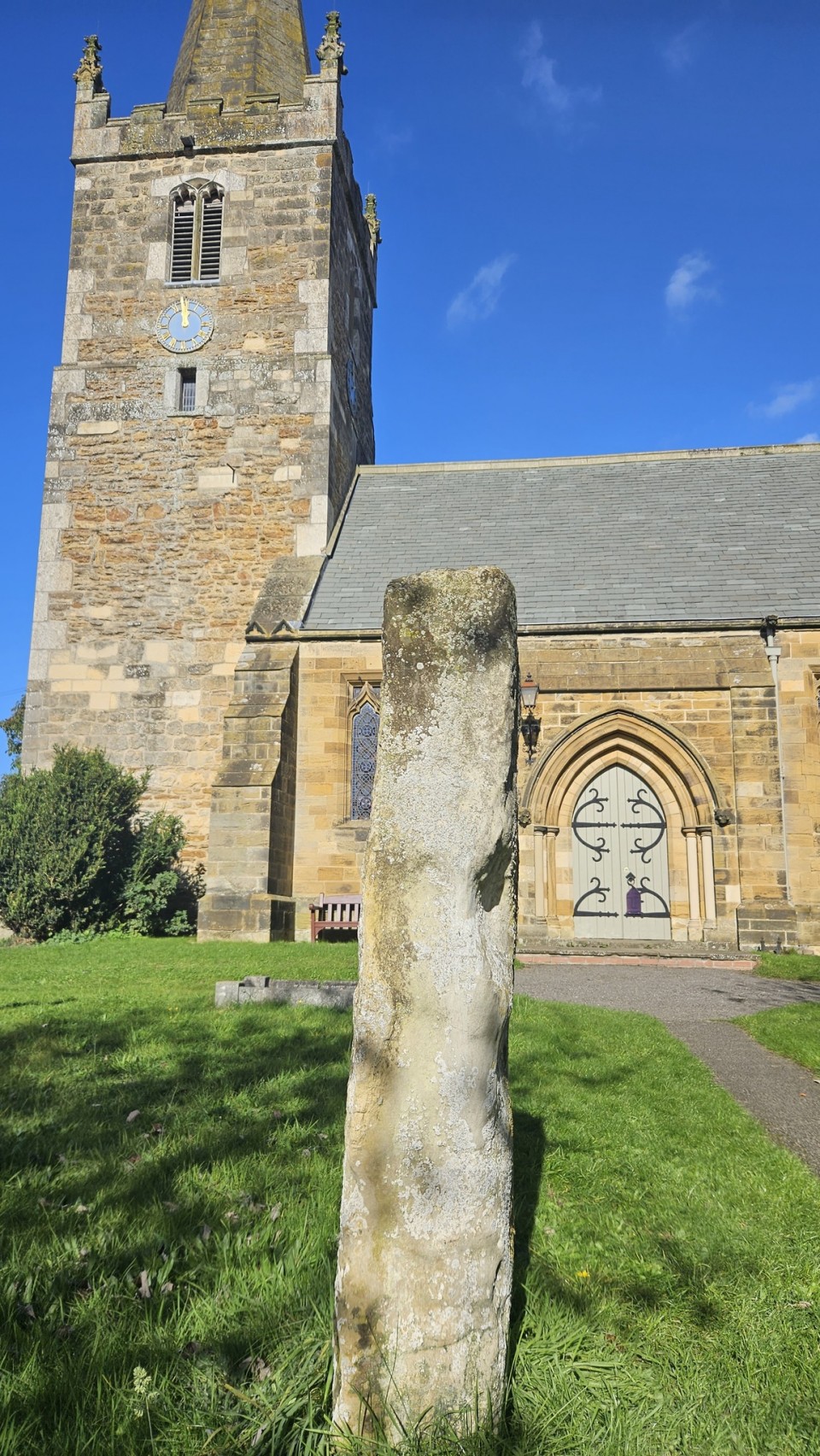
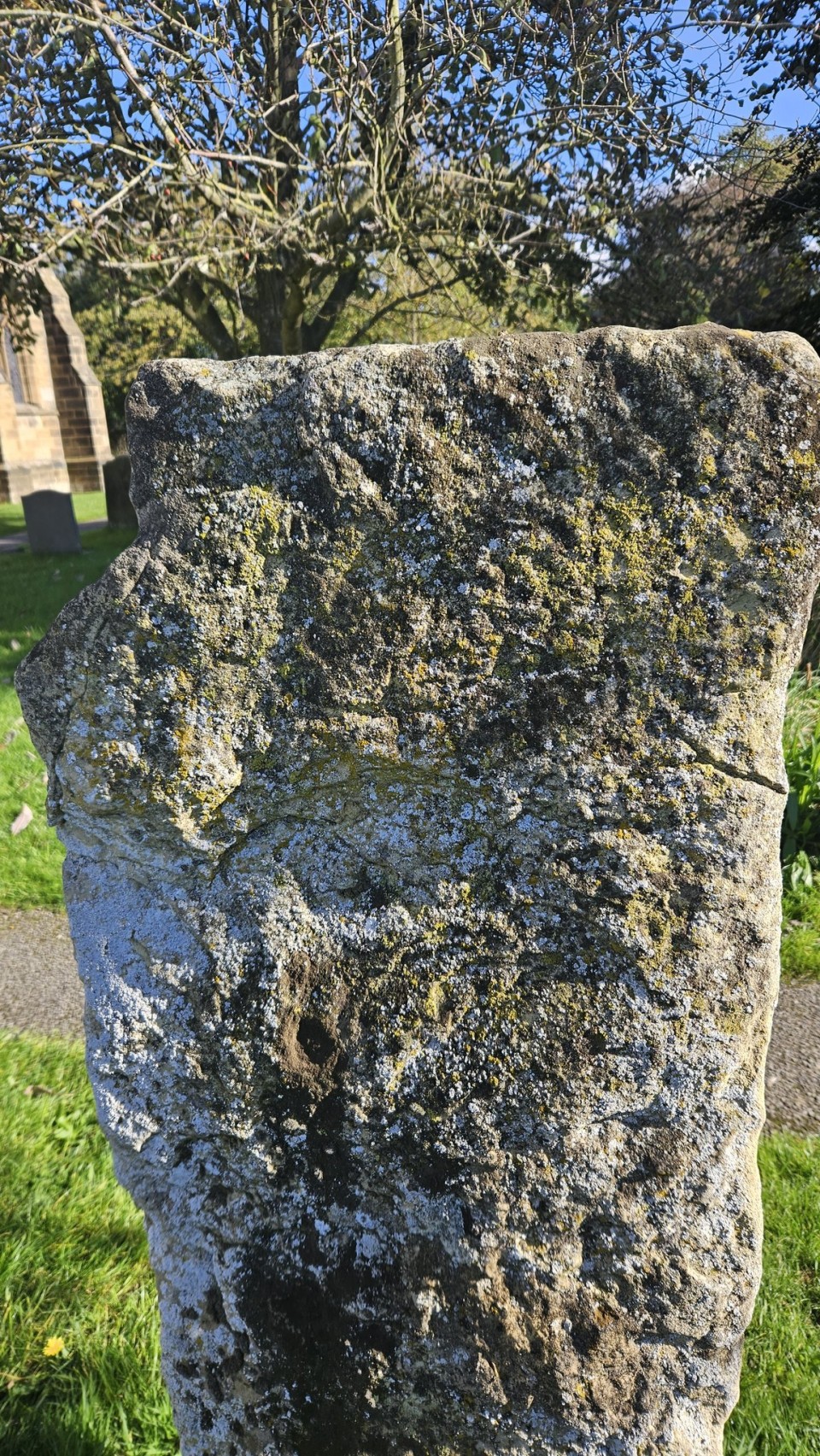
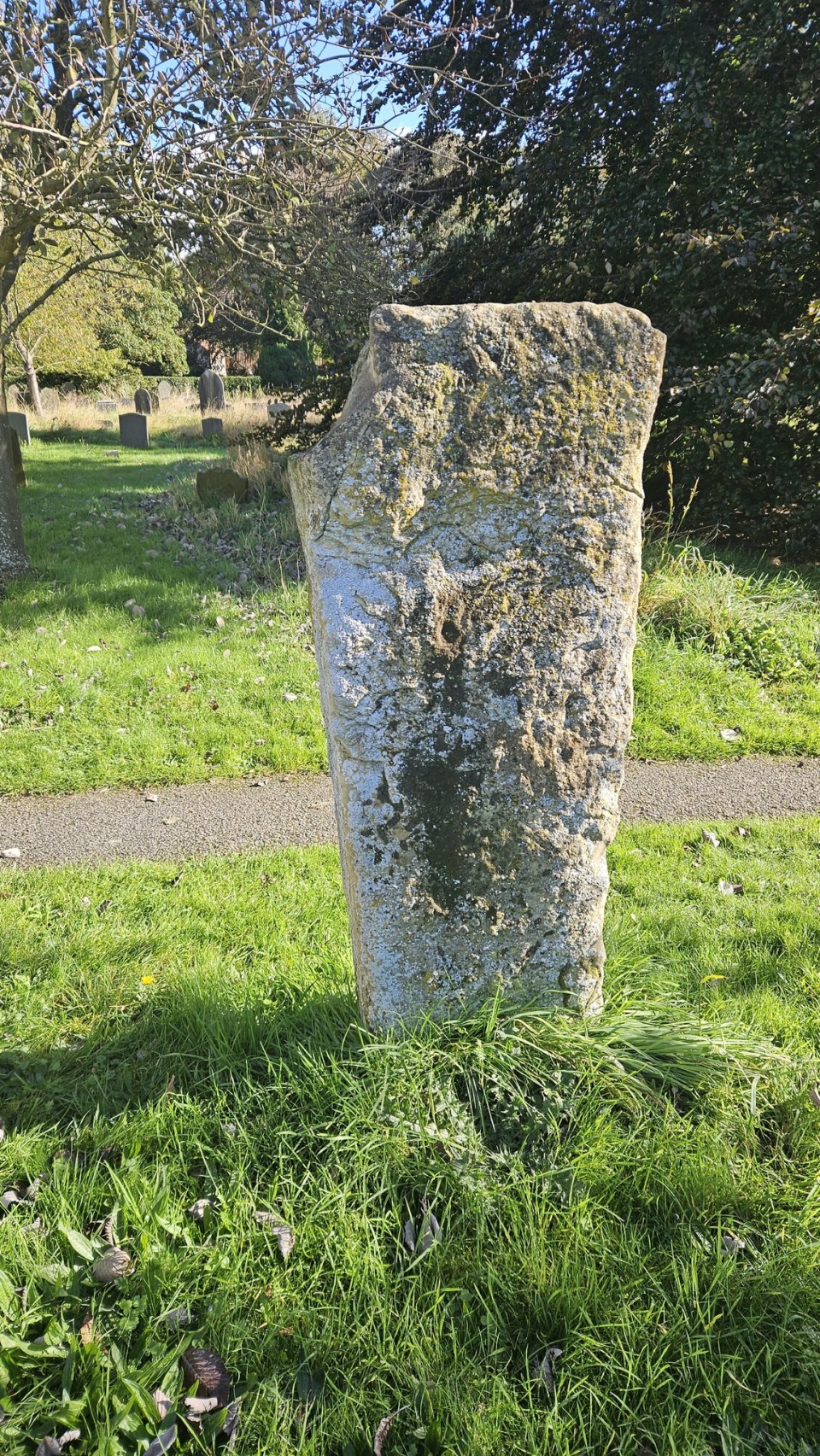
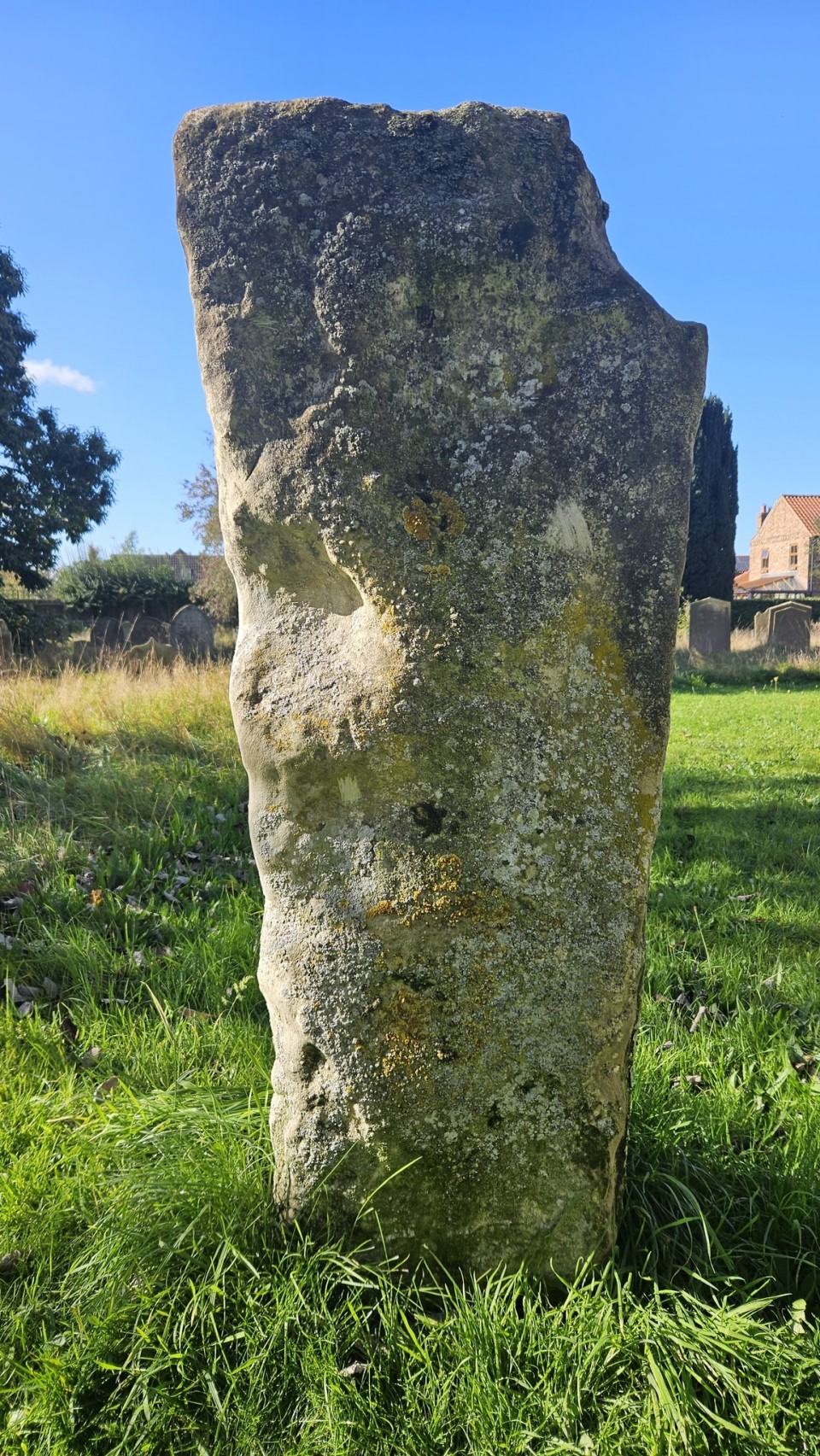
We met the kindly farmer's wife and got permission to cross the field by the education centre and into their field of sheep. The stone sits just below the highest point, square and upright, glittering in the sun. The lambs dance around in the field, some posing by the stone, but it stands strong.
Taking one's bearing as you look towards the sea and the Goldsborough Lane that you must take to find the other stone, it has probably been there as a track for hundreds of years.
We drove along the lane and saw the North stone in the distance, it is on the other side of the narrow wood or Carr, strange that they are so similar but had something else to do so another visit one day.
One reason we went out was because this stone is the flagship for the restoring of Ancient Scheduled Monuments under the North York Moors Monument Management Scheme, £200,000 is on the table for various schemes, including a 3,500 year old cairnfield with burial mounds.
Also the footpaths have been repaired at the Bronze Age burial mounds at Lilla Howe, Simon Howe and the Two Howes on Goathland under this scheme, presumably because people are WALKING OVER THE MOUNDS, Wales is obviously not the only place to have this problem.
Donkeys do have quite dainty feet, but even so, this first snippet perhaps supports the idea the holes are a bit big for human-created rock art. But that they require supernatural explanation is interesting in itself.
Here in Northumberland [pot holes] are the hoof-marks of a devil as at Birtley, or basins formed by Queen Mab and her train for bathing in, as tradition pleasingly narrates, at Rothley. The soul has almost gone out of such legends now, but time was when they were of earnest import to mankind.
The Rev. G. R. Hall, F.S.A., has told the Birtley legend in a former Volume of these Transactions. A wandering demon, once upon a time, was unwary enough to drink at the Holy Well. But the sacred water disagreed with him like molten lead, and dashing his hoofs upon the stone he leaped a full mile from the spot. He alighted upon the rock beside the Leap Crag Pool in the North Tyne; in which deep black hole "tradition averreth he was drowned." At the Holy Well the tracks are about the size of a small donkey's, if I dare use the comparison, and consist of several pairs as if the miserable being had waxed fidgetty; beside the pool they swell to the size of an elephant's.
But if the marks are natural, the stone doesn't sound near the water? It's all rather unclear. Oh to nip up in the Van to check, it being a fine Sunday in (almost) summer.
The Birtley Halywell, or Holy Well, a chalybeate spring, issuing from the face of the sandstone cliff, amidst the ferns, harebells, heather, and other flowers that adorn its interstices, close to the romantic waterfall of the Holywell Burn, and to the curious so-called Devil's Stone, or Rock, in the near neighbourhood also of two ancient British camps, or oppida, is worthy of special mention among the medicinal wells of North Tynedale.
Though I cannot learn that any particular reverence was formerly shown to this well, which now merely trickles down the ochreous sides of the cliff, at Midsummer, yet I find that people "from far and near" used until recently to visit it on fine Sunday afternoons in summer, and itinerant vendors of refreshments from the village, which is about a mile distant, were wont to be present on the spot. Here, in close proximity, still exists the great upright, weather-worn monolith-- apparently a detached fragment split from the adjacent rock by some natural convulsion --already spoken of as the Devil's Stone. Tradition asserts this to have been, "once upon a time," the scene of a Satanic leap, the very "hoof-marks" being yet visible on its altar-like summit in the shape of what geologists would call "pot holes" -- a leap intended to result in the demon's descent at Lee Hall, on the opposite bank of the river, about half a mile distant; but the interval not having been carefully estimated, the consequence was a fall into the deepest abyss of North Tyne, just below the Countess Park Clints -- thence called the "Leap-Crag Pool," where the Satanic personage is said to have been drowned!
From Archaeologia Aeliana volume 8 (1880), in an article called 'Notes on Modern Survivals of Ancient Well-Worship in North Tynedale.." by the Rev. G. Rome Hall.
A tradition, which I first heard during the progress of our excavations, was known to a former shepherd's wife, an aged dame, who had often spoken to her family of her desire to dig into the great mound in search of "the treasure of silver" said to be secreted in this great fairy knoll, so like the Gaelic "shian" associated with the hero Ossian. Children of the cottage have since told me they had often danced upon it and heard something "rattle and jingle" beneath their feet. Strange it is that the old dame's wish had not long ago been gratified; but, deterred by superstitious feeling, the mystery of the cairn remained unrevealed.
From the 1887 Archaeologia Aeliana article "Recent explorations in ancient British barrows, containing cup-marked stones, near Birtley, North Tynedale", by the Rev. G. Rome Hall.
Another and seemingly older interpretation of the name:
Oaks of a great size, firm and sound, have been taken out of a large moss on Bewick-Moor, called King's Moss, by the road from Chillingham to Alnwick, near a noted aperture in a freestone-rock, called Catherine's cave.
And for another version of the story about bold adventurers exploring the tunnel, it's rather fun to see George Tate himself do the retelling, in The Border Magazine, November 1863.